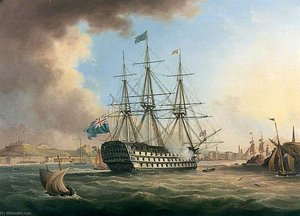
Thomas Lyde Hornbrook (1780–1855): A Pioneer of Victorian Maritime Painting
Thomas Lyde Hornbrook emerged as a prominent figure in the British art scene during the Victorian era, leaving an indelible mark on maritime painting and capturing the spirit of his time. Born in Plymouth, England, in 1780, he inherited a lineage steeped in naval tradition – his father, Richards Lyde Hornbrook, served with distinction in the Royal Marines – shaping his artistic vision and fostering a lifelong fascination with the sea.
- Early Life & Education: Little is known about Hornbrook’s formative years beyond his familial connection to the military. However, he received a solid grounding in classical art principles, likely influenced by the prevailing academic style of the period. This foundation would prove crucial for honing his artistic skills and developing his distinctive approach.
- Career Highlights: Hornbrook's professional life commenced around 1830 when he secured the prestigious position of marine painter to the Duchess of Kent and her daughter, Victoria – a patronage that propelled him into the spotlight and afforded him access to influential circles. This association not only provided financial stability but also exposed him to royal commissions and fostered collaborations with fellow artists.
- Notable Works: Hornbrook’s artistic output encompassed numerous captivating seafaring scenes, meticulously rendered with remarkable detail and imbued with a palpable sense of atmosphere. Among his most celebrated paintings are “HMS Pallas Entering Plymouth Harbour,” “HMS Pique” Sailing from the Hamoaze to Plymouth Sound, and “A Frigate and Other Vessels in Barn Pool off Plymouth.” These works exemplify his mastery of technique—particularly watercolor—and his ability to convey the grandeur and drama of naval life.
- Technique & Style: Hornbrook’s artistic style was characterized by a commitment to realism combined with an expressive handling of color and light. He skillfully employed watercolor pigments, layering washes and glazes to achieve luminous effects that captured the shifting moods of the sea and sky. His compositions prioritized accuracy in depicting ships and their surroundings, yet he infused them with emotional resonance—reflecting the anxieties and aspirations of Victorian Britain.
- Legacy & Influence: Hornbrook’s contribution to maritime art is undeniable. He established himself as one of the foremost watercolorists of his era, influencing subsequent generations of artists who sought to emulate his meticulous observation and emotive rendering. His paintings continue to resonate with viewers today, serving as evocative reminders of a bygone age—a testament to his enduring artistic legacy.
Further research into Hornbrook’s life and oeuvre reveals connections to the burgeoning scientific interest in marine biology during the Victorian era. He was particularly drawn to depictions of coastal landscapes and wildlife, reflecting the broader cultural preoccupation with exploring and documenting the natural world. His work stands as a compelling intersection between artistic expression and intellectual curiosity—a facet of his artistic identity that deserves further consideration.