Sylvia Palacios Whitman: Surreal Minimalism and the Choreographic Canvas
Sylvia Palacios Whitman (born August 25, 1941) stands as a singular figure in performance art history—a Chilean-American artist who fused visual painting with movement into an arresting exploration of space, gesture, and materiality. Her work transcends conventional categorization, embodying the spirit of avant-garde experimentation while retaining a profound connection to Latin American artistic traditions. Whitman’s trajectory began in Santiago, Chile, where she honed her skills as a painter and sculptor at Universidad de Chile's Fine Arts School before embarking on a transformative journey to New York City in 1961. This relocation proved pivotal, immersing her in the burgeoning experimental theater scene of the early sixties and establishing collaborations with influential artists like Robert Whitman—a relationship that would profoundly shape her artistic vision.
- Early Influences & Training: Whitman’s formative years were marked by exposure to Chilean Surrealism and Constructivism, disciplines which instilled in her a fascination for paradoxical juxtapositions and the manipulation of form to convey complex ideas. Her formal education provided foundational knowledge in drawing and sculpture, equipping her with technical precision alongside an imaginative sensibility.
- Collaboration with Robert Whitman: Whitman’s partnership with Robert Whitman—a fellow performance artist—was instrumental in shaping her artistic approach. Together they explored the intersection of visual art and theater, pioneering a distinctive style characterized by layered imagery and deliberate choreography. Their collaborative endeavors solidified Whitman's commitment to blending disparate mediums into unified expressive experiences.
- The Trisha Brown Dance Company Years (1970-1973): Whitman’s involvement with Trisha Brown’s dance company represented a crucial step in her artistic development. This association exposed her to the principles of “choreographic theater,” where movement served as an integral component of storytelling and visual presentation. Performances by Brown challenged conventional theatrical conventions, emphasizing physicality and spatial exploration—influences that would permeate Whitman's subsequent work.
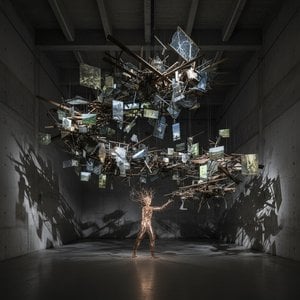
Whitman’s performance practice centered on creating immersive environments populated by carefully crafted props and costumes—often incorporating found objects—that functioned as both symbolic representations and active participants in the unfolding drama. Her pieces frequently employed repetitive movements, mirroring the rhythms of daily life yet simultaneously disrupting expectations through unexpected gestures and spatial configurations. Recurring motifs included spirals, squares, and geometric patterns—visual elements that echoed structural principles found in Chilean architecture and reinforced Whitman’s preoccupation with exploring relationships between form and content. Notably, her work consistently interrogated themes of identity, displacement, and the negotiation between individual experience and collective consciousness.
- Notable Performances: Whitman's performances gained recognition for their conceptual rigor and aesthetic subtlety. Key works include *Going* (1974), *Soup & Tart* (1975), *Red Cone* (1976), *Passing Through* (1977), *Negatives* (1981) and *South*(1979). These pieces explored the tension between stillness and movement, inviting audiences to contemplate the complexities of human interaction and perception.
- Materiality & Symbolism: Whitman’s artistic language prioritized materiality—particularly paper—as a medium for conveying ideas about transformation and decay. Her use of simple geometric forms—squares, spirals, circles—served as visual anchors within her performances, grounding abstract concepts in tangible realities. Recurring imagery reflected Chilean cultural heritage and underscored Whitman's engagement with broader philosophical questions concerning the nature of existence.
Whitman’s influence extends beyond her own artistic output; she fostered a dialogue between painting and dance, demonstrating how these disciplines could enrich each other's expressive potential. Her work continues to inspire artists interested in exploring unconventional approaches to storytelling and visual representation—a testament to Whitman’s enduring legacy as a pioneer of performance art and a champion of surreal minimalism. Her retrospective exhibitions at institutions like Hammer Museum and the Whitney Museum solidified her position as an artist whose singular vision captivated audiences worldwide.