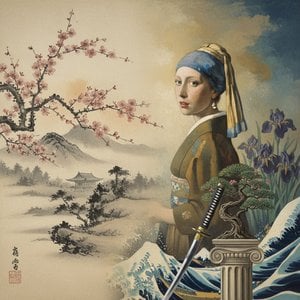
Ushio Shinohara: The Explosive Dialogue Between Tradition and Pop
Ushio Shinohara (b. 1932) stands as a singular figure in Japanese contemporary art, recognized for his groundbreaking “Boxing Paintings” – a visceral exploration of gesture and materiality that simultaneously confronts the legacies of Dadaism and the burgeoning influence of pop art. Born in Tokyo amidst the turbulent backdrop of postwar Japan, Shinohara’s artistic journey began with formal training at the Tokyo Art University, where he honed his skills before embarking on a transformative relocation to New York City in 1969. This move cemented his position within the international avant-garde and propelled him into a dialogue with influential artists like Jasper Johns and Robert Rauschenberg, whose techniques—particularly appropriation and assemblage—became foundational to Shinohara’s distinctive approach.- Early Influences: Shinohara's formative years were marked by the pervasive impact of American occupation on Japanese society, fostering a critical awareness of cultural exchange and challenging established artistic conventions. His exposure to Dadaist principles – spontaneity, anti-rationality, and rejection of academic standards – profoundly shaped his aesthetic sensibilities.
- The Boxing Paintings: The genesis of Shinohara’s signature oeuvre lies in 1960–1, where he conceived the revolutionary “Boxing Paintings.” Rejecting traditional painting methods, he eschewed gesture-based abstraction for a more mechanical process utilizing industrial materials like cardboard and airbrush. This deliberate departure from established artistic practices underscored his commitment to pure action—a concept championed by Gutai artists—and served as a powerful critique of Abstract Expressionism’s dominance.
- Neo-Dada Organizers: Shinohara's involvement with the Neo Dada Organizers Group solidified his role as a pivotal voice in Japan’s experimental art scene. Alongside fellow artists, he championed radical ideas and challenged conventional artistic hierarchies, establishing a collective dedicated to exploring new forms of expression.
- Oiran Series & Pop Art Synthesis: Shinohara's exploration of Japanese iconography—specifically the *oiran*, a high-class courtesan depicted in Edo-period woodblock prints—represents a masterful synthesis of tradition and pop art aesthetics. He transformed the stylized image into a vibrant, multifaceted artwork utilizing fluorescent paint, plastic, and aluminum sheets, reflecting on themes of modernity and cultural appropriation.
Notable Exhibitions & Recognition
Shinohara’s work has garnered international acclaim and been showcased in prestigious institutions across the globe. Key exhibitions include: Hara Museum of Contemporary Art (Tokyo), Centre Georges Pompidou (Paris), Guggenheim Museum SoHo (New York), National Museum of Modern Art, Tokyo; National Museum of Modern Art, Kyoto; Leo Castelli Gallery; Museum of Contemporary Art, Los Angeles; and Japan Society (New York). His participation in *Cutie and the Boxer*, a documentary film by Zachary Heinzerling, further cemented his artistic reputation and brought his distinctive practice to a wider audience.Legacy & Artistic Significance
Ushio Shinohara’s contribution to contemporary art transcends mere stylistic innovation; he embodies a spirit of intellectual curiosity and unwavering commitment to challenging artistic boundaries. His relentless pursuit of pure action—a rejection of representational art—served as an inspiration for subsequent generations of artists, while his masterful blending of tradition and pop aesthetics continues to resonate with audiences today. Shinohara’s enduring influence underscores the transformative power of experimentation and the importance of confronting established conventions in the ongoing dialogue between artistic heritage and cultural dynamism.Spørgsmål & svar
Kan jeg gennemse Shinohara Ushios værker efter stemning?
Kunstnerens Stemningsrum side viser Shinohara Ushios værker arrangeret efter deres atmosfære.
Findes der en tidslinje over Shinohara Ushios værker?
Kunstnerens Tidslinje for kunstværker side præsenterer Shinohara Ushios værker sorteret efter dato, år for år.
Hvordan finder jeg værker af Shinohara Ushio inden for et specifikt tema?
Siden Efter nøgleord for Shinohara Ushio grupperer kunstnerens værker efter deres nøgleord.