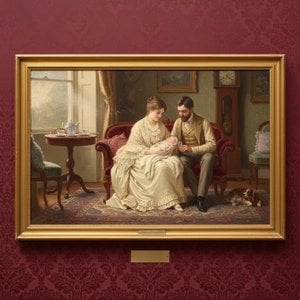
Sara Hennell (or Cara Bray): A Victorian Visionary Bridging Art and Intellect
Born in the bustling heart of Hackney, London, in 1812, Sara Sophia Hennell – often recognized as Cara Bray – emerged from a family steeped in intellectual curiosity and dissenting Unitarian beliefs. Her life intertwined inextricably with that of George Eliot, Charles Christian Hennell, and her sister Caroline Bray, forming a vibrant circle of thinkers and artists who profoundly shaped the literary and artistic landscape of 19th-century England. More than just an artist, Hennell was a keen observer of domestic life, a thoughtful chronicler of landscapes, and a significant contributor to the intellectual debates of her time – a rare combination for a woman of her era.
Her early years were marked by close familial bonds and a stimulating environment. Raised within a Unitarian household—a tradition emphasizing reason and individual conscience—she received an education that fostered both artistic talent and critical thinking. The influence of her brother, Charles Christian Hennell, a theologian and apologist who famously challenged the evidence for Christian beliefs, proved particularly formative. This intellectual sparring shaped her own perspective and contributed to her eventual embrace of skepticism. Her association with the Brays—Cara’s marriage to Charles in 1836—further cemented this intellectual trajectory, exposing her to radical ideas and a circle of progressive thinkers.
A Watercolorist of Quiet Moments
Hennell's artistic output primarily consists of watercolor paintings, capturing scenes of domestic tranquility and the beauty of the English countryside. These works are not grand historical narratives or dramatic portraits; instead, they offer intimate glimpses into everyday life—a window reflecting a snowy winter scene, a chapel nestled in a village, or a peaceful wooded vista. Her skill lay in her ability to convey atmosphere and emotion through subtle color palettes and delicate brushstrokes.
Notable among her works is “Rosehill, Coventry (female heads verso),” a captivating watercolor depicting the window of the Bray’s home overlooking a snowy landscape. The painting isn't merely a representation of a view; it’s imbued with a sense of longing and introspection—a visual echo of the intellectual conversations that unfolded within those walls. Similarly, “The Chapel, Hackney” offers a serene portrayal of her relocation to Coventry, while "Churchyard and porch, wooded far view big house" showcases her talent for capturing the tranquility of rural settings. Her self-portrait, painted in 1889, provides a poignant glimpse into the artist’s own identity and artistic vision.
Connections to George Eliot and the Meyrick Family
Hennell's most significant connection lies with George Eliot (Mary Ann Evans), whose life and work were deeply intertwined with her own. Their friendship began in 1842 at Rosehill, the Bray’s home in Coventry, and blossomed into a correspondence that spanned over two decades. This intellectual partnership extended beyond mere pleasantries; Hennell actively engaged with Eliot's writing process, offering feedback and suggestions on translations of key philosophical texts, including Strauss’ *Das Leben Jesu*.
The influence of this relationship is particularly evident in the creation of the fictional Meyrick family within George Eliot’s novel *Daniel Deronda*. The characters Kate, Amy, and Mab—a trio of sisters grappling with identity and social constraints—are widely believed to be based on Hennell, Bray, and their circle. This connection elevates Hennell's work beyond mere artistic production; it positions her as a foundational element in Eliot’s literary world.
Legacy and Historical Significance
Sara Hennell’s legacy is one of quiet intellectualism and understated artistry. While she may not be widely celebrated today, her paintings offer valuable insights into the domestic life and artistic sensibilities of Victorian England. Her association with George Eliot—a figure whose work continues to resonate profoundly—solidifies her place within a pivotal moment in literary history.
Her contributions extend beyond the realm of art; Hennell’s skepticism and engagement with philosophical debates reflect a broader intellectual movement challenging established orthodoxies. The Herbert Art Gallery and Museum in Coventry houses several of her paintings, ensuring that her work remains accessible to contemporary audiences. Ultimately, Sara Hennell represents a fascinating example of a woman artist who navigated the constraints of her time while forging her own unique path—a testament to the power of observation, intellect, and artistic expression.