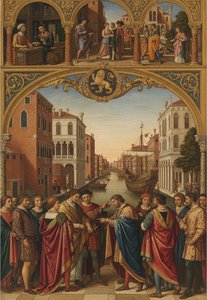
Rocco Marconi: A Venetian Voice Amidst the Shadows of Tintoretto
Rocco Marconi (c. 1490 – 1529) stands as a singular figure within the vibrant tapestry of Venetian Renaissance painting, a talent whose brilliance shone briefly but powerfully amidst the towering presence of masters like Tintoretto and Veronese. While overshadowed by his contemporaries in terms of fame and prolific output, Marconi’s contribution to Venetian art history is undeniable—a testament to artistic sensitivity and an exploration of religious iconography that reveals a distinctive stylistic voice.
Early Life and Artistic Training
Information regarding Marconi's precise birthdate remains elusive, placing him squarely within the turbulent years following Leonardo da Vinci’s departure from Milan. Born in Treviso, Marconi’s formative years were steeped in the artistic traditions of Veneto, where Giovanni Bellini reigned supreme as a teacher and mentor. He studied under Bellini alongside Vittore Belliniano and Girolamo Santacroce—artists who would themselves become prominent figures in Venetian art circles—absorbing the humanist ideals and stylistic refinements that characterized Bellini’s oeuvre. This tutelage instilled in Marconi a profound understanding of perspective, chiaroscuro, and the expressive potential of color – techniques that would subsequently inform his own artistic endeavors.
Marconi's Artistic Style: A Delicate Balance
Marconi’s paintings are distinguished by their remarkable subtlety and emotional depth—qualities often absent in the bolder canvases produced during the Venetian Renaissance. Unlike Tintoretto’s dramatic chiaroscuro, Marconi favored a more restrained palette and luminous brushwork, prioritizing atmospheric perspective and nuanced tonal gradations. His compositions frequently depict scenes of biblical narratives, notably depictions of Christ – a preoccupation that reflects the spiritual fervor of his time. However, Marconi's approach wasn’t merely imitative; he possessed an innate ability to imbue his subjects with palpable emotion, capturing moments of profound contemplation and conveying spiritual yearning through delicately rendered gestures and expressions.
Notable Works and Influences
Marconi’s artistic output is relatively modest compared to other Venetian painters of his era, yet several paintings bear witness to his considerable skill and sensitivity. Among his most celebrated works are depictions of Christ Pantocrator—a monumental altarpiece housed in the chiesa di San Rocco in Venice—and a series of smaller panels featuring scenes from the Gospels. These canvases demonstrate Marconi’s mastery of technique and his unwavering commitment to conveying religious piety.
The influence of Giovanni Bellini is undeniably evident in Marconi's style, particularly in his use of color and compositional structure. However, Marconi also absorbed elements from other artists active during his time, including Andrea Mantegna and Piero della Francesca—masters who championed mathematical precision and idealized beauty. These influences contributed to Marconi’s distinctive artistic vision, shaping his approach to portraying religious subjects with grace and dignity.
Legacy and Historical Significance
Rocco Marconi's life was tragically cut short in 1529, leaving behind a legacy of approximately twenty paintings—a comparatively small collection considering the scale of Venetian art production during the Renaissance. Despite this limited output, Marconi’s work continues to fascinate scholars and connoisseurs alike—a testament to his artistic integrity and his ability to capture the essence of Christian faith with understated elegance. His paintings stand as a poignant reminder that true artistry resides not merely in grand spectacle but in profound emotional resonance – a distinction that secures Marconi's place as an important, albeit often overlooked, voice within the Venetian Renaissance canon.