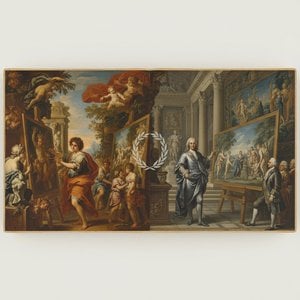
A Life Dedicated to Divine Detail: The World of Pietro Bianchi
Pietro Bianchi, born in Genoa in 1694 and passing away in 1740, was a painter whose life unfolded amidst the transition from the High Baroque to the burgeoning Rococo style. Though not as widely celebrated as some of his contemporaries, Bianchi carved a significant niche for himself within the artistic circles of both Genoa and Rome, becoming renowned for his meticulous technique, deeply religious subject matter, and an ability to imbue even the simplest still life with a captivating sense of presence. His career, though relatively short, demonstrates a dedication to capturing not merely the appearance of reality but also its spiritual essence.
From Genoese Beginnings to Roman Flourishing
Bianchi’s early artistic training remains somewhat shrouded in mystery; however, it is believed he initially honed his skills within the workshops of Genoa, a city then experiencing a vibrant period of artistic activity fueled by its maritime wealth and connections to other European centers. The influence of Genoese masters like Gregorio De Ferrari, known for their dramatic compositions and rich color palettes, likely played a role in shaping Bianchi’s initial style. Around the early 1720s, Bianchi relocated to Rome, a pivotal move that would profoundly impact his artistic development. In Rome, he immersed himself in the city's grand artistic heritage, studying the works of Caravaggio, Guercino, and other Baroque giants. This exposure broadened his understanding of light, shadow, and emotional intensity, elements that became hallmarks of his mature work. He quickly established a reputation for painting altarpieces and devotional scenes for churches and private patrons throughout Rome and its surrounding regions.
Themes of Faith and the Everyday
Bianchi’s oeuvre is characterized by two primary thematic strands: religious narratives and still life compositions. His religious paintings, often depicting saints or scenes from the lives of Christ and the Virgin Mary, are notable for their emotional depth and realistic portrayal of human figures. He possessed a remarkable ability to convey piety and spiritual fervor through subtle gestures, expressive faces, and carefully orchestrated lighting effects. St Francis of Paola in Ecstasy, exemplifies this talent; the saint is depicted lost in prayer, radiating an inner peace that draws the viewer into a moment of profound contemplation. Beyond his religious works, Bianchi also excelled at still life painting. These compositions, featuring arrangements of fruits, flowers, and everyday objects, are not merely exercises in technical skill but rather meditations on mortality, abundance, and the beauty of the natural world. He often included symbolic elements within these still lifes—a wilting flower representing the transience of life, or a partially peeled fruit alluding to hidden desires—adding layers of meaning beyond their surface appearance.
Technique and Influences
Bianchi’s technical prowess was widely admired by his contemporaries. He employed a meticulous brushstroke, building up forms with layers of delicate glazes that created a luminous quality in his paintings. His mastery of chiaroscuro—the dramatic contrast between light and shadow—was particularly evident in his religious scenes, where it served to heighten emotional impact and draw attention to key figures. While firmly rooted in the Baroque tradition, Bianchi’s style also reveals influences from the emerging Rococo aesthetic. This is visible in his use of softer colors, more graceful compositions, and a greater emphasis on decorative details. He wasn't necessarily a revolutionary figure; rather, he synthesized existing styles into something uniquely his own—a blend of Baroque drama and Rococo elegance. His work stands as a testament to the enduring power of artistic training and the ability to adapt to changing aesthetic sensibilities.
Legacy and Historical Significance
Although Pietro Bianchi did not achieve widespread fame during his lifetime, his paintings continue to be appreciated for their technical brilliance, emotional depth, and insightful portrayal of both religious faith and everyday life. His work provides valuable insight into the artistic climate of 18th-century Italy, bridging the gap between the grandeur of the Baroque and the delicate refinement of the Rococo. While further research is needed to fully understand his life and career, Bianchi’s paintings remain a compelling reminder of the enduring power of art to inspire contemplation, evoke emotion, and capture the beauty of the world around us. His dedication to detail and skillful execution ensure that his legacy will continue to resonate with viewers for generations to come.