Panos Terlemezian: A Voice for Armenian Identity Through Symbolist Landscapes
Panos Terlemezian (1865-1941) stands as a pivotal figure in Armenian art history, embodying not only artistic talent but also unwavering dedication to his nation’s cultural preservation and nationalist aspirations. Born in Ağstafa, Turkey, Terlemezian's early life was marked by an innate passion for painting—a fascination nurtured from childhood and solidified by the mentorship of Mekertich Portukalian, who recognized his potential and encouraged him to pursue a path toward artistic excellence. This formative influence would prove instrumental in shaping his lifelong commitment to capturing the spirit of Armenia through evocative landscapes and portraits.
From 1881 to 1885, Terlemezian honed his skills at Portukalian’s private college, where he joined forces with fellow Armenian nationalists—a collaboration that foreshadowed his enduring involvement in advocating for Armenian rights and autonomy. His subsequent teaching position in Van provided him with invaluable experience in fostering artistic appreciation amongst younger generations, while also exposing him to the complexities of Ottoman governance and its impact on Armenian communities. The arrest of 1890, stemming from accusations of opposing Ottoman rule—though ultimately unfounded—served as a catalyst for his exile and deepened his conviction in the importance of resistance against oppression.
Driven by nationalist fervor, Terlemezian fled Iran in 1893, relocating to Tbilisi where he continued his artistic pursuits alongside fellow intellectuals and artists. His work at the printing office and newspaper Mshak further cemented his connection to Armenian cultural discourse, demonstrating a commitment to disseminating Armenian language and culture. Seeking formal artistic training, he traveled to St. Petersburg, benefiting from the patronage of Lev Dmitriev-Kavkazsky and immersing himself in the stylistic innovations of Symbolism—a movement that profoundly impacted his artistic vision. The encouragement of MKrtich Khrimian fueled his ambition and provided crucial financial support during this formative period.
A brief foray into Estonia in 1897 culminated in another arrest and detention, orchestrated by the Ottoman government under pressure to suppress Armenian dissent. Subsequently extradited to Yerevan, Terlemezian endured further hardship and exile—experiences that undoubtedly informed his artistic sensibilities and deepened his understanding of Armenian suffering. Recognizing the need for artistic education, he established a painting school alongside Leon Kyurkchyan, nurturing talent and fostering a sense of Armenian identity within Tbilisi’s artistic landscape. His extensive journey through North Africa in 1908 offered fresh inspiration and broadened his artistic horizons before returning to Paris where he continued his studies at Académie Julian with Jean-Paul Laurens and Jean-Joseph Benjamin-Constant—completing his artistic education under the guidance of respected masters.
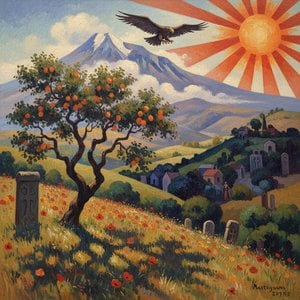
Returning to Tbilisi in 1904, Terlemezian resumed his teaching role at Nersisian School, continuing to champion Armenian culture and fostering artistic creativity amongst students. His travels throughout Armenia and beyond fueled his artistic inspiration, resulting in a prolific output of landscapes imbued with Symbolist aesthetics—characterized by muted palettes, textured surfaces, and an emphasis on conveying emotion rather than mere representation. Notably, Terlemezian’s portraiture reflects a humanist concern for capturing the inner life of his subjects, demonstrating a sensitivity to psychological nuance alongside technical virtuosity. His legacy resides not only in his artistic achievements but also in his unwavering dedication to Armenian nationalism—a commitment that ensured his art served as a powerful expression of Armenian identity and resilience throughout his lifetime.