Nicaise de Keyser: A Belgian Romantic’s Historical Vision
Nicaise de Keyser, born in Zandvliet, Belgium, on August 26th, 1813, and passing away in Antwerp on July 17th, 1887, stands as a pivotal figure within the Belgian Romantic-historical school of painting. His career, spanning over seven decades, witnessed a fascinating evolution from early religious works to grand historical narratives, ultimately cementing his place as one of the most celebrated artists of his era. De Keyser’s legacy is inextricably linked to the burgeoning national identity of Belgium and the powerful imagery used to evoke its past—a past rich with battles, heroism, and the spirit of resistance.Early Years and Artistic Training
De Keyser's artistic journey commenced at the Antwerp Academy of Fine Arts, where he received rigorous instruction from esteemed masters Jozef Jacobs and Mattheus Ignatius van Bree. These formative years instilled in him a solid foundation in classical techniques while simultaneously exposing him to the burgeoning Romantic movement gaining momentum across Europe. Crucially, his travels following 1835 – encompassing England, Scotland, Paris, and Italy – broadened his artistic horizons significantly. These experiences weren’t merely vacations; they were deliberate immersions into diverse artistic traditions, influencing his palette, composition, and approach to subject matter. The Parisian influence is particularly evident in the later adoption of a more dramatic and theatrical style, mirroring the grand narratives favored by French Romantic painters. His marriage to Isabella Telghuys, a talented genre painter herself, provided a supportive partnership that undoubtedly enriched his creative life.The Breakthrough: The Battle of the Golden Spurs
De Keyser’s career truly ignited with the exhibition of “Battle of the Golden Spurs” (1836) at the Brussels Salon. This monumental canvas, depicting the pivotal 1302 battle between France and Flanders, became an instant sensation. It wasn't simply a historical record; it was a carefully constructed allegory for Belgian independence—a theme that resonated deeply with the nation’s aspirations following years of foreign rule. The painting’s dynamic composition, vibrant colors, and dramatic lighting immediately captured the public’s imagination, establishing de Keyser as a leading voice in the Belgian Romantic movement. The success of this single work propelled him to prominence, inspiring Hendrik Conscience to pen his influential novel “De Leeuw van Vlaanderen” (The Lion of Flanders), further solidifying the painting's cultural significance and cementing its place within Belgian national mythology.Historical Themes and Artistic Style
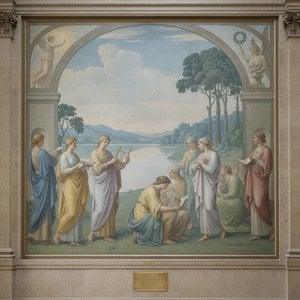
Throughout his prolific career, de Keyser consistently focused on historical subjects—battles, sieges, and significant events in Belgium’s past. He wasn’t merely recreating historical scenes; he was actively shaping a narrative of Belgian identity. Works such as “Battle of Worringen” (1862) and the series of decorative paintings commissioned for the Antwerp Royal Museum further demonstrate this commitment to celebrating Flemish history and heritage. His style, while rooted in academic traditions, possessed a distinctly Romantic sensibility—characterized by dramatic lighting, dynamic compositions, and an emphasis on emotional intensity. He skillfully blended Baroque compositional techniques with a vibrant color palette reminiscent of Romanticism, creating works that were both historically accurate and emotionally engaging. Notably, his paintings often featured heroic figures embodying courage, sacrifice, and national pride.Recognition and Legacy
Despite achieving considerable acclaim during his lifetime—including election to the National Academy of Design as an honorary academician in 1846 and receiving the prestigious Prussian “Pour le Mérite” order in 1873 – de Keyser’s work experienced a period of relative obscurity following World War II. The artistic landscape shifted dramatically, favoring modern movements, and the Romantic-historical school largely faded from public consciousness. However, in recent decades, there has been a renewed appreciation for de Keyser's contributions to Belgian art history. His paintings are now recognized as significant examples of 19th-century historical painting, reflecting both the artistic trends of his time and the evolving national identity of Belgium. His influence can still be seen in the works of numerous students he mentored, including Léon Abry, Aloïs Boudry, and Edgard Farasyn, ensuring that his legacy continues to resonate within Belgian art circles. His prolific output – estimated at over 350 paintings – stands as a testament to his dedication and artistic vision.Spørgsmål & svar
Findes der en tidslinje over Nicaise de Keysers værker?
Kunstnerens Tidslinje for kunstværker side præsenterer Nicaise de Keysers værker sorteret efter dato, år for år.
Hvordan kan jeg se alle værker skabt af Nicaise de Keyser?
Alle værker af Nicaise de Keyser på denne hjemmeside kan gennemses via kunstnerens Alle kunstværker-side.
Hvordan er Nicaise de Keysers karriere opdelt i perioder?
En kronologisk gennemgang af Nicaise de Keysers værker er tilgængelig på kunstnerens Kronologi-side, hvor kunstværkerne præsenteres i rækkefølge efter deres skabelse, kapitel for kapitel.