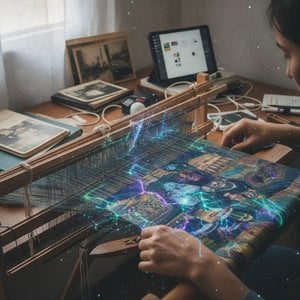
A Rising Voice in Contemporary Ikat: The Story of Hitesh Rawat
Born in Andhra Pradesh, India, in 2011, Hitesh Rawat represents a fascinating new generation of textile artists bridging the gap between ancient tradition and modern aesthetic sensibilities. While still incredibly young, Rawat’s impact on the world of ikat design is already being felt, demonstrating a remarkable maturity and understanding of both the technical complexities and cultural weight inherent in this storied weaving practice. His journey isn't simply about replicating patterns; it’s about revitalizing a heritage through innovative collaboration and thoughtful exploration.
Early Life and Artistic Beginnings
Growing up surrounded by the rich textile traditions of Andhra Pradesh undoubtedly shaped Rawat’s artistic vision. The region is renowned for its vibrant handloom weaving, particularly ikat – a technique where yarns are resist-dyed before being woven to create intricate patterns that seem to shimmer with life. While formal training details remain limited due to his young age, it's clear that early exposure to the skilled artisans and complex processes of local weaving communities played a pivotal role in fostering his passion. Rawat’s initial work focused on understanding the fundamentals of ikat – mastering the precise calculations required for resist-dyeing, the nuances of color blending, and the rhythmic movements involved in the weaving process itself.
Collaboration and the Jiyo! Sari
A significant early achievement came through a collaboration with Jiyo!, an online platform promoting Indian artisans. Rawat designed a striking sari and blouse woven by the talented Jella Sudhakar. This wasn’t merely a design commission; it was a partnership built on mutual respect and a shared commitment to preserving traditional crafts. The resulting piece – a silk sari featuring a bold, red abstract design – is a testament to this synergy. The choice of silk as a base material speaks to the luxury and refinement associated with ikat weaving, while the abstract pattern introduces a contemporary element that broadens its appeal. This project, co-designed with Avanish Kumar, brought Rawat’s work to a wider audience and established him as a promising new voice in the textile art world.
Exploring Technology and Craft Dialogue
Rawat's artistic exploration extends beyond specific projects; he actively seeks connections between technology and traditional craft practices. He doesn’t view these realms as opposing forces but rather as complementary tools for innovation. His work often involves traveling to different parts of India, immersing himself in diverse weaving communities – from the IKAT textiles of Telangana to hand-knotted carpets in Dharamshala with Tibetan artisans, block printing in Gujarat and Madhya Pradesh, and further weaving explorations in Himachal Pradesh, Uttar Pradesh, and Bihar. This nomadic approach allows him to absorb a wide range of techniques and perspectives, enriching his own creative process. He has worked on projects involving wooden blocks and cotton fabrics, experimenting with layouts, compositions, and visuals.
Historical Significance and Future Trajectory
While still at the beginning of his career, Hitesh Rawat’s work holds significant promise for the future of Indian textile art. He embodies a new generation of artists who are not content to simply preserve tradition but actively seek ways to evolve it. His collaborations with platforms like Jiyo! and his dedication to working directly with artisans demonstrate a commitment to ethical practices and sustainable development. Rawat’s ability to seamlessly blend traditional techniques with contemporary aesthetics positions him as a key figure in the ongoing dialogue between heritage and innovation. He is not just designing textiles; he is weaving a narrative of cultural preservation, artistic collaboration, and the enduring power of human creativity. His association with the Asian Heritage Foundation further underscores his dedication to safeguarding India’s rich artistic legacy.
Spørgsmål og svar
Kan jeg udforske Mr Hitesh Rawats værker efter farvespektrum?
Farveindeks for Mr Hitesh Rawat er en side, der organiserer kunstnerens værker efter farve.
Findes der et overblik over alle de motiver, som Mr Hitesh Rawat har malet?
Emneoversigt for Mr Hitesh Rawat er en side, der kortlægger kunstnerens værker efter deres motiver.
Kan jeg gennemse Mr Hitesh Rawats værker efter stemning?
Stemningsfulde rum for Mr Hitesh Rawat er en side, hvor kunstnerens værker er organiseret efter stemning.