The Enigmatic Master of the Riccardiana Lactantius
Florence’s ‘Master of the Riccardiana Lactantius,’ a shadowy figure in Renaissance art history, remains largely unknown despite producing some remarkably sophisticated illuminated manuscripts. Precise biographical details are scarce—his birth year is estimated to be around 1470, and his death occurred shortly thereafter—leaving scholars to reconstruct his artistic career primarily through stylistic analysis of his surviving works. He operated within the vibrant Florentine artistic milieu of the second half of the fifteenth century, benefiting from the patronage of influential families like the Medici and immersing himself in the humanist intellectual currents that shaped the era.
- Early Life & Training: Precise information about his formative years is elusive. Like many artists of his time, he likely received training within the workshops of established masters, absorbing techniques and stylistic conventions prevalent at the Florentine Scuola Grande di San Luca. However, unlike many contemporaries who signed their works, the Master of the Riccardiana Lactantius left no definitive trace of his personal identity—a puzzling omission that contributes to the enduring fascination surrounding his oeuvre. His dedication to mastering the craft of disegno – drawing – undoubtedly underpinned his remarkable artistic achievements.
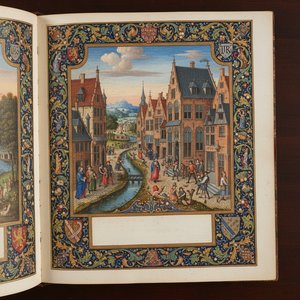
- Illustrations of Lactantius’ Writings: His fame rests almost entirely on his meticulous illustrations of Lactantius Firmianus’ *De Vita Sancti Jacobi*, a Christian apologetic text exploring the veneration of Saint James the Apostle. These manuscripts exemplify the Riccardiana style—characterized by exceptional detail, vibrant color palettes achieved through tempera and gold leaf gilding, and an astonishing level of artistic virtuosity. The depiction of Saint James's tomb is considered a masterpiece of perspective and anatomical realism, reflecting the humanist ideals championed by Florentine intellectuals during his time.
- Technique & Style: The Master’s technique is remarkable for its precision and sensitivity to texture. He employed a layered approach, applying thin washes of pigment over meticulously prepared parchment sheets—a method that ensured maximum luminosity and visual impact. His illustrations are distinguished by their expressive draughtsmanship, capturing subtle nuances of emotion and gesture with unparalleled accuracy. Furthermore, he skillfully integrated gold leaf into the decorative program, creating shimmering surfaces that enhanced the overall grandeur of the manuscripts. This meticulous attention to detail – a hallmark of Florentine art – speaks volumes about his artistic vision.
- Notable Manuscripts & Patronage: Among his most celebrated creations is Folio 6 of Riccardiano Codex 1030—a lavishly ornamented manuscript commissioned by Lorenzo de’ Medici—which showcases the pinnacle of Riccardiana style. The intricate depiction of Saint James's tomb and surrounding figures demonstrates a masterful command of perspective and anatomical realism, reflecting the humanist ideals championed by Florentine intellectuals during his time. This commission underscores the importance of patronage in fostering artistic innovation and preserving cultural heritage.
- Legacy & Influence: Although his identity remains shrouded in mystery, the Master of the Riccardiana Lactantius’ contribution to manuscript illumination is undeniable. His work stands as a testament to the artistic excellence of Florence during its golden age—a period marked by intellectual ferment and unparalleled creative innovation. He continues to inspire admiration among art historians and scholars who strive to unravel the enigma surrounding this elusive Renaissance artist, cementing his place in the annals of Florentine art history. His influence can be seen in subsequent artists who embraced similar stylistic conventions and pursued ambitious projects aimed at elevating the visual arts.
Further Exploration:
*
Biblioteca Riccardiana: Visit Palazzo Medici Riccardi in Florence to admire a stunning 17th-century library housing rare manuscripts and incunabula—a tangible connection to the artistic heritage of the Renaissance.
*
Galerie Alte - Neue Meister: Explore Dutch Masters, Duchamp’s revolutionary art, and Uecker’s sculptures at Galerie Alte – Neue Meister in Schwerin, Germany – a unique blend of historical and modern masterpieces.
*
Strossmayer Gallery: Discover Croatian art from the 14th-19th centuries, including Old Masters & the Baška Tablet at Strossmayer Gallery in Zagreb!