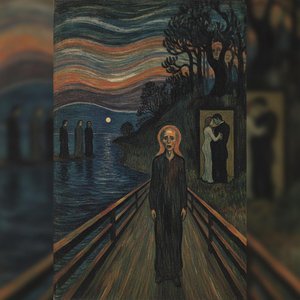
A Life of Artistic Wandering
Born Marta Szostakowska into a Jewish family in Łódź, Poland, the artist’s journey was one defined by a relentless pursuit of creative freedom. Despite facing opposition from her family, she refused to accept the conventional paths of art teaching available in her homeland. Instead, she embarked on a peripatetic existence, traveling through Poland, Switzerland, and Germany to refine her craft. Her search for an expressive voice eventually led her to the vibrant artistic atmosphere of Paris, where she began to establish herself within the European art scene.
Her life was deeply intertwined with international diplomacy and movement. Following her marriage to an Iranian diplomat, Abel Hassan Hekimi, her horizons expanded significantly. She spent long periods in Persia (Iran), a landscape and culture that left an indelible mark on her creative vision. This nomadic lifestyle, spanning from the streets of Europe to the far reaches of the Middle East, provided a rich tapestry of influences that would later manifest in the profound depth of her imagery.
The Language of Inner Reality
The work of Marthe Hekimi—as she was known—transcended mere imitation of the natural world. Guided by the belief that a true twentieth-century artist should not simply copy nature, she sought to capture an inner reality through more or less abstract forms. Her aesthetic was a captivating blend of Surrealism and fantasy, often weaving together human and animal figures into imaginative compositions. This expressive technique allowed her to explore themes that were both deeply personal and universally resonant.
During the tumultuous years of the war, her art took on a more somber, reflective tone. She produced a series of 'Fantasies' in pen-and-ink on paper, works that grappled with existential concerns. Pieces such as 'Fear' and 'Catastrophe' serve as poignant witnesses to the era, reflecting the anxieties of a world in conflict. Her subject matter frequently touched upon the complexities of human existence, including themes of conflict, resolution, and the enduring hope for the future.
Legacy and Recognition
Hekimi’s career was marked by significant exhibitions that brought her work to the attention of the international community. In Paris, she exhibited at the Galerie Jeanne Bucher-Myrbor in 1936, and later appeared with Max Bill’s Allianz group in the Kunsthaus Zurich in 1942. Her presence in the London art world was also notable; she held two-person shows at the Ben Uri Gallery in 1947, 1948, 1949, and 1950, even gifting works to their permanent collection.
Beyond her canvases, Hekimi engaged with the world through diplomatic and humanitarian channels, serving on the League of Nations' Council of the Equal Rights International. This commitment to justice and human rights found a mirror in her art, which often dealt with the struggle for recognition and belonging. Today, her legacy survives through the evocative power of her paintings and drawings, which continue to bridge the gap between the historical trauma of the twentieth century and the timeless exploration of the human spirit.
Spørgsmål og svar
Kan jeg udforske Marta Szostakowskas værker efter emne?
Emneoversigt for Marta Szostakowska er en side, der kortlægger kunstnerens værker efter deres motiver.
Hvor kommer Marta Szostakowska fra?
Marta Szostakowska blev født i Poland.
Hvilken by og hvilket land er Marta Szostakowska født i?
Marta Szostakowska blev født i Lodz, i Poland.