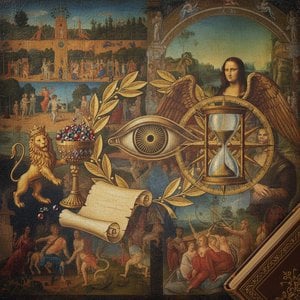
The Architect of Unfathomable Realms
Luigi Serafini, born in Rome in 1949, occupies a singular space in the contemporary imagination, acting as both an architect of physical structures and a cartographer of impossible worlds. To encounter his work is to step into a liminal space where the boundaries between reality and dream dissolve. Raised within an artistic lineage, Serafini’s early life was steeped in the nuances of form and design, a foundation that would later allow him to bridge the gap between the rigorous logic of architecture and the fluid chaos of surrealist fantasy. His academic journey through ETH Zurich and the Universitiá degli Studi di Milano provided him with a sophisticated understanding of spatial dynamics, yet his true calling lay in the construction of languages and symbols that defy the constraints of human comprehension.
The defining moment of Serafini’s career—and perhaps one of the most significant achievements in late 20th-century conceptual art—is the publication of the Codex Seraphinianus in 1981. This monumental work serves as an encyclopedia of a non-existent world, rendered through meticulous, hand-drawn illustrations and an entirely invented alphabet. The Codex is not merely a book; it is a profound provocation against the tyranny of linguistic meaning. By presenting a system of communication that is intentionally undecipherable, Serafini forces the viewer to abandon the search for literal translation and instead engage with the pure, visceral power of visual perception. Within its pages, biological anomalies, surrealist fashion plates, and bizarre botanical specimens coexist in a state of beautiful, unsettling harmony.
A Symphony of Metalanguage and Form
Beyond the enigmatic borders of his famous codex, Serafini’s artistic evolution has been marked by a relentless pursuit of "metalanguage"—a way to communicate through objects that exist outside of traditional semiotics. His practice is characterized by an extraordinary versatility, moving seamlessly from the structural precision of architectural design to the whimsical textures of ceramic sculpture and the theatrical grandeur of ballet set design. Each medium serves as a vessel for his fascination with the strange and the unseen. In his sculptural endeavors, one finds a tactile exploration of form that mirrors the organic yet alien shapes found in his illustrations, creating a cohesive universe where the physical and the imaginary are inextricably linked.
The technical mastery evident in his work is nothing short of breathtaking. Whether he is rendering the intricate, vibrant patterns of an alien fashion plate or sculpting complex, multi-layered objects, there is a palpable sense of painstaking detail. His ability to evoke emotion through purely aesthetic means—without the crutch of recognizable language—is what elevates his work from mere fantasy to profound philosophical inquiry. He invites us to consider the nature of existence and the fragility of our own systems of understanding. Through his art, the viewer is encouraged to embrace the mystery of the unknown, finding beauty in the very things that remain forever beyond our grasp.
Legacy and the Infinite Horizon
The historical significance of Luigi Serafini lies in his ability to challenge the fundamental relationship between the observer and the observed. In an era dominated by rapid information exchange and the constant demand for clarity, Serafini offers a sanctuary of ambiguity. His work stands as a testament to the enduring power of the imagination and the possibility of creating meaning through pure aesthetic experience. He has fundamentally altered the landscape of contemporary design by proving that art can operate entirely independently of established linguistic or cultural systems.
Today, the influence of Serafini’s visionary approach can be seen across various disciplines, from surrealist illustration to experimental typography and conceptual installation. His legacy is not found in a single movement, but in the enduring fascination with the "untranslatable." As we continue to navigate an increasingly complex world, the enigmatic landscapes of the Codex Seraphinianus and the tactile wonders of his metalanguage objects remain vital, reminding us that the most profound truths are often those that cannot be spoken, only felt.