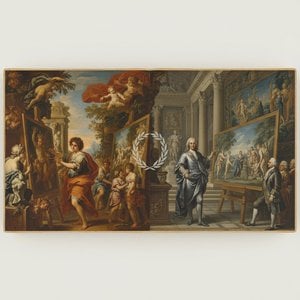
Louis de Silvestre: The Painter of Royal Grace
Louis de Silvestre, a name perhaps less familiar than those of his contemporaries, nevertheless stands as a pivotal figure in the late Baroque and early Rococo art world of France. Born in Sceaux, just south of Paris, in 1675, he wasn’t simply a painter; he was a meticulous craftsman, a courtier’s confidant, and an artist deeply influenced by both classical tradition and the burgeoning spirit of his time. His career spanned over eight decades, marked by a consistent elegance and a remarkable ability to capture the nuances of aristocratic life, earning him positions of considerable prestige – first as court painter to Augustus II, King of Poland, and later as director of the Royal Academy of Arts in Dresden.
Silvestre’s early artistic development was shaped by his father, Israel Silvestre, a renowned engraver and drawing master who served as tutor to Louis XIV's Grand Dauphin. This foundational training instilled in young Louis a rigorous approach to draughtsmanship and an appreciation for the detailed observation of form. He then benefited from instruction under Charles Le Brun and Bon Boullogne, established masters of the French court style. However, it was his time in Rome that truly cemented his artistic vision. There, he encountered Carlo Maratta, whose dynamic compositions and masterful use of light profoundly impacted Silvestre’s approach to painting. This Roman influence is particularly evident in his later works, characterized by a sense of theatrical drama and an emphasis on capturing fleeting moments of emotion.
The Polish Court and the Rise of a Master
In 1716, Louis de Silvestre embarked on a significant chapter of his career when he accepted an invitation from Augustus II to become court painter in Poland. This move proved transformative, not only for his artistic development but also for his reputation. He quickly established himself as a favorite amongst the Polish nobility, renowned for his portraits that captured both their outward grandeur and inner personalities. The King and Queen were particularly appreciative of his work, bestowing upon him numerous honors – including ennoblement in 1741 – solidifying his position at the heart of the royal court.
During his time in Poland, Silvestre’s output was prolific. He produced a vast array of portraits, many depicting members of the royal family and other prominent figures. However, he also undertook ambitious decorative projects for the royal palaces, notably frescos within the Dresden palace itself. These works demonstrate his versatility as an artist, moving beyond individual portraits to create large-scale murals that adorned ceremonial spaces. The subject matter often drew inspiration from Ovid’s *Metamorphoses*, a testament to Silvestre's engagement with classical literature and mythology – a theme he would continue to explore in Dresden.
Dresden: A Palace of Visions
Silvestre’s tenure as director of the Royal Academy of Arts in Dresden marked a new phase in his career. He oversaw the training of young artists, fostering a vibrant artistic community within the city. His own work during this period reached an unprecedented level of sophistication, characterized by a refined elegance and a masterful command of color and composition. The palace itself became a canvas for his creativity, with elaborate decorations adorning numerous rooms – from grand state chambers to intimate private spaces.
Amongst his most celebrated Dresden works are the frescos depicting scenes from Ovid’s *Metamorphoses*. These monumental paintings showcase Silvestre's ability to seamlessly blend classical mythology with Baroque aesthetics. The “Arion playing the Lyre” is a particularly striking example, capturing the drama and emotion of the myth in a visually stunning composition. Furthermore, his portraits of Augustus III and his family are considered masterpieces of their time, revealing an acute understanding of human psychology and a remarkable talent for conveying character through subtle gestures and expressions.
Legacy and Influence
Louis de Silvestre’s legacy extends beyond the individual works he created. He represents a crucial link between the Baroque traditions of France and the emerging Rococo style, embodying a synthesis of classical learning and aristocratic patronage. His meticulous draftsmanship, his elegant compositions, and his ability to capture the nuances of human emotion have ensured his place as one of the most important portrait painters of his era.
His influence can be seen in the work of subsequent generations of artists, particularly those who followed him at the Dresden Academy. Silvestre’s dedication to artistic excellence and his commitment to fostering a vibrant artistic community left an enduring mark on the cultural landscape of Saxony. Though often overshadowed by more flamboyant contemporaries, Louis de Silvestre deserves recognition as a skilled and influential artist whose work continues to captivate viewers today.
Spørgsmål og svar
Hvilke farver brugte Louis de Silvestre oftest?
Farveprofilen for Louis de Silvestres værker kan ses på kunstnerens Farvepalettens DNA-side.
I hvilken historisk periode arbejdede Louis de Silvestre?
Louis de Silvestre var aktiv i Early Modern-perioden. Denne periode placerer kunstnerens virke i en historisk kontekst.
Hvor kan jeg finde statistik om Louis de Silvestres værker?
Der findes en Statistik-side for Louis de Silvestre, som præsenterer statistikker om kunstnerens værker på denne hjemmeside.