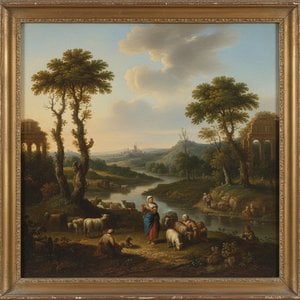
A Life Immersed in Light and Landscape
Karel Dujardin, a name resonating softly within the pantheon of Dutch Golden Age masters, was born in Amsterdam in 1626 – though some records suggest 1622. His life unfolded during a period of unprecedented artistic flourishing in the Netherlands, yet his path wasn’t one of immediate acclaim but rather a gradual unfolding of talent nurtured by careful study and extensive travel. Details surrounding his early years remain somewhat elusive, shrouded in the mists of time, however it is widely accepted that he received foundational training under Nicolaes Berchem, a painter celebrated for his idyllic landscapes populated with animals. This mentorship proved pivotal, instilling in Dujardin a deep appreciation for naturalism and a keen eye for capturing the subtle nuances of light and atmosphere. But Dujardin’s artistic journey wasn't confined to the studios of Amsterdam; he possessed an adventurous spirit that led him to Rome, where he became a member of the *Bentvueghels*, a society of predominantly Dutch and Flemish painters who embraced a bohemian lifestyle and often adopted satirical nicknames. In Rome, he was known as “Barba di Becco” or "Goat-Beard," a moniker likely referencing his distinctive facial hair, and it was here that his artistic voice truly began to mature.Early Training and Artistic Foundations
Dujardin’s formative years were marked by an immersion in the artistic traditions of Amsterdam. His apprenticeship under Nicolaes Berchem wasn't merely about acquiring technical skills; it instilled within him a profound understanding of how to represent the natural world with accuracy and beauty. Berchem’s landscapes, characterized by luminous colors and meticulous detail, served as an invaluable model for Dujardin, shaping his aesthetic sensibilities and establishing a cornerstone of his artistic style. This influence is palpable in many of Dujardin's later works, where he consistently strives to emulate Berchem’s masterful depiction of light and atmosphere—a testament to the enduring power of mentorship and the transmission of artistic knowledge across generations.The Roman Influence: Embracing Satire and Experimentation
Dujardin’s decision to relocate to Rome in 1650 represented a significant turning point in his artistic career. Joining the *Bentvueghels*, he embraced a vibrant intellectual and social milieu that fostered experimentation and challenged conventional artistic norms. This society of painters, renowned for its satirical sketches and flamboyant nicknames—including “Barba di Becco”—provided Dujardin with an environment conducive to pushing boundaries and exploring new stylistic approaches. The Roman landscape captivated him, inspiring compositions infused with Italianate grandeur and a fascination with classical motifs. Simultaneously, he honed his skills in portraiture, producing striking likenesses that captured not only physical appearance but also psychological character—a skill that would become central to his artistic legacy.Genre Painting: Capturing Everyday Life
Dujardin’s artistic output is predominantly characterized by genre paintings – scenes depicting ordinary life with remarkable realism and sensitivity. Unlike the idealized depictions favored by some of his contemporaries, Dujardin focused on portraying rural landscapes populated with animals—particularly cows—and domestic interiors inhabited by peasants engaged in their daily routines. His canvases are imbued with a palpable warmth and immediacy, conveying a profound appreciation for the beauty found in commonplace subjects. Consider Woman Milking a Red Cow; the artist’s meticulous attention to detail—from the texture of the cow’s hide to the subtle interplay of light and shadow—transforms an unremarkable activity into a moment of contemplative grandeur. This dedication to observation and representation distinguishes Dujardin from many other artists of his time, elevating genre painting to new heights of artistic achievement.Notable Works and Legacy
Karel Dujardin produced a prolific oeuvre spanning landscapes, portraits, and historical scenes—a testament to his versatility as an artist and his unwavering commitment to mastering various techniques. Among his most celebrated paintings are Rest at an Italian Inn, which captures the atmosphere of a Tuscan tavern with evocative detail; The Regents of the Spinhuis and Nieuwe Werkhuis, Amsterdam, a monumental group portrait showcasing the dignity and solemnity of Dutch governance; and Self-Portrait (1662), offering an intimate glimpse into the artist’s own personality. His works are held in prestigious institutions worldwide—including the Mauritshuis Royal Picture Gallery in The Hague and the National Gallery in London—affirming their enduring artistic merit and securing his place as one of the foremost figures of Dutch Golden Age painting. Dujardin's influence can be seen in subsequent generations of artists who sought to emulate his masterful technique and his profound understanding of the human condition, ensuring that his legacy continues to inspire admiration and scholarly study for centuries to come.Spørgsmål og svar
Hvor kommer Karel Dujardin fra?
Karel Dujardin blev født i Holland.
Kan jeg besøge et virtuelt museum med Karel Dujardins værker?
Besøg galleriet virtuelt: 3D-galleri-siden for Karel Dujardin præsenterer kunstnerens værker i et tredimensionelt galleri.
Kan jeg studere Karel Dujardins farvebrug på tværs af alle værker?
Farvepalettens DNA for Karel Dujardin er en side, der præsenterer farveprofilen i kunstnerens samlede værk.