A Life Interrupted, A Vision Forged: The Story of Julian Stanczak
Julian Stanczak’s life was a testament to the resilience of the human spirit and the transformative power of art. Born in 1928 in Borownica, Poland, his early years were idyllic no more than twelve years old when the shadow of World War II descended upon Europe, irrevocably altering the course of his existence. The brutal reality of conflict saw him and his family forcibly deported to a Siberian labor camp – an experience that would leave indelible marks on both body and soul. Within the camp’s harsh confines, Stanczak sustained a severe injury to his right arm, resulting in permanent impairment. This physical challenge, compounded by the trauma of displacement and suffering, might have broken many, but for young Julian, it became a catalyst for reinvention. Forced to adapt, he retrained himself to paint with his left hand, a symbolic act of defiance against adversity that would define his artistic journey.
From Siberian Exile to American Abstraction
Escape from Siberia in 1942 marked the beginning of another arduous chapter. Stanczak joined the Polish Army-in-Exile, but ultimately deserted, seeking refuge first in Uganda and then in London. These years spent as a displaced person were formative, exposing him to diverse cultures and landscapes that would later inform his artistic sensibility. It was in Africa, amidst the vibrant colors and patterns of the natural world, that he began to seriously pursue art, receiving initial instruction from a fellow Polish refugee. This early exposure ignited a passion that would sustain him through years of uncertainty. In 1950, Stanczak emigrated with his family to the United States, settling in Cleveland, Ohio, where he formally pursued artistic training at the Cleveland Institute of Art, earning his Bachelor of Fine Arts degree in 1954. He continued his studies at Yale University School of Art and Architecture, immersing himself in the principles of Bauhaus design and abstract expressionism under the tutelage of Josef Albers and Conrad Marca-Relli, culminating in a Master of Fine Arts degree in 1956.
The Birth of Op Art and Stanczak’s Defining Contribution
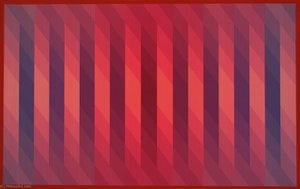
Stanczak's artistic evolution led him towards geometric abstraction, but it was his meticulous exploration of color relationships, line, and spatial illusion that truly set him apart. He sought to create dynamic visual experiences for the viewer, challenging perceptions and pushing the boundaries of traditional painting. This pursuit culminated in a pivotal moment in 1964 when art critic Donald Judd coined the term “Op Art” – Optical Art – in a review of Stanczak’s exhibition, Julian Stanczak: Optical Paintings, at the Martha Jackson Gallery in New York. This show established him as a leading figure in this emerging movement, characterized by its use of geometric patterns and optical illusions to create a sense of movement or vibration. His contributions were notable for their precision, sophisticated color theory, and repeating forms that created an illusion of depth and dynamism. The inclusion of his work in the influential 1965 exhibition The Responsive Eye at the Museum of Modern Art further solidified his place within the art world. Stanczak wasn’t merely creating paintings; he was conducting visual experiments, inviting viewers to actively participate in the perception of his artwork.
A Legacy Beyond the Canvas: Teaching and Enduring Influence
Beyond his artistic practice, Julian Stanczak dedicated himself to education. He served as an instructor at the Art Academy of Cincinnati from 1957 to 1964 before becoming a Professor of Painting at the Cleveland Institute of Art, a position he held until his retirement in 1995. He was recognized for his commitment to teaching, receiving the "Outstanding American Educator" award in 1970. Even as Op Art’s initial fervor subsided, Stanczak continued to refine his techniques and expand his artistic vocabulary, exploring geometric abstraction with unwavering dedication. His later work often incorporated large-scale formats and complex color modulations, demonstrating a lifelong fascination with visual perception. Julian Stanczak passed away in 2017, leaving behind a substantial body of work that continues to inspire and captivate audiences worldwide. His ability to transform personal adversity into a powerful artistic vision is a testament to his resilience and creative spirit. He remains an important figure in 20th-century American art, celebrated for his pioneering role in Op Art and his enduring commitment to exploring the complexities of how we see the world around us.