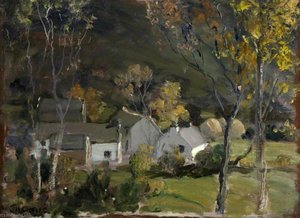
The Donegal Romantic: The Life and Vision of James Humbert Craig
James Humbert Craig (1877–1944) remains a singular figure in the annals of Irish art history, celebrated primarily for his breathtaking landscapes that capture the raw, untamed spirit of County Donegal and Connemara. A painter whose work breathes with the salt spray of the Atlantic and the mist of the Ulster highlands, Craig possessed an undeniable sensitivity to the grandeur of the natural world. Though largely self-taught, his artistic vision was profound, possessing a dramatic intensity that cemented his place as one of the most influential landscape painters of his era. His life was a journey from the structured comforts of Dublin to the rugged, windswept edges of the Irish coast, a transition that mirrored his evolution from a student of nature to a master of the romantic sublime.
Born in Dublin in 1877 into a wealthy Protestant family, Craig’s early years were shaped by a lineage of tradition and land. His father, Sir Henry Craig, was a prominent barrister and landowner, an upbringing that instilled in young James a deep-seated respect for the heritage of the landscape and an appreciation for the majesty of the natural environment. This formative period provided the foundation for his later explorations of the Irish wilderness. While he did not pursue the rigorous academic training typical of many of his contemporaries, Craig developed his skills through meticulous observation and tireless experimentation with oil on canvas. He found profound inspiration in the works of American Romantic masters such as Frederic Church and Albert Bierstadt. From these titans of the Hudson River School, he learned to compose vast, sweeping vistas that utilized light and scale to evoke a sense of awe and emotional depth, a technique that would become the hallmark of his mature style.
A Mastery of Light and Atmosphere
The true turning point in Craig’s career arrived in 1903, when he relocated to the rugged landscapes of Donegal. Drawn by the dramatic topography of the region—its towering mountains, windswept beaches, and ancient peat bogs—he established a studio overlooking the historic Lough Eske Castle. It was here that his artistic breakthrough occurred, as he embarked on an ambitious project to document the Irish landscape with unprecedented detail and emotional intensity. His canvases began to pulsate with a vibrant, living color palette; deep blues and emerald greens reflected the turbulent Atlantic Ocean and the verdant, rain-soaked hillsides of the north.
Craig’s technique was characterized by a remarkable ability to capture the shifting light and atmospheric conditions of Ireland's unpredictable seasons. He utilized meticulous brushstrokes to render the texture of stone, the translucency of water, and the heavy, moisture-laden air that defines the Atlantic coast. His work often moved beyond mere topographical representation, seeking instead to convey the sublime—that specific intersection of beauty and overwhelming power found in nature. Through his eyes, the Glens of Antrim and the rugged reaches of Connemara were transformed into epic stages where light and shadow performed a continuous, dramatic dance.
Legacy and Historical Significance
The significance of James Humbert Craig lies not only in the beauty of his compositions but in his role as a chronicler of a specific Irish romanticism. At a time when much of Irish art was navigating complex political and cultural identities, Craig’s focus remained steadfastly on the eternal, elemental landscape. His work provided a visual language for the grandeur of the Ulster coastline, capturing a sense of place that felt both intimately local and universally epic. His ability to blend the meticulous detail of a naturalist with the sweeping emotion of a romanticist allowed his work to resonate far beyond the borders of Ireland.
Today, Craig is remembered as a master of the Irish landscape, an artist whose legacy is etched into the very hills and coasts he so lovingly depicted. His contributions to the tradition of Irish landscape painting continue to inspire, serving as a testament to the power of observation and the enduring allure of the wild. His life’s work remains a vital part of the Irish artistic canon, offering a window into a period where the rugged beauty of the land was captured with a soul-stirring reverence that continues to captivate audiences worldwide.
Spørgsmål og svar
Hvor populære er James Humbert Craigs kunstværker?
Se statistik over James Humbert Craigs værker på kunstnerens Statistik side.
Hvordan finder jeg værker af James Humbert Craig inden for et specifikt tema?
For at finde værker af James Humbert Craig inden for et specifikt tema kan du bruge kunstnerens Efter nøgleord-side, som grupperer værkerne efter nøgleord.
Hvilke farver brugte James Humbert Craig oftest?
Farveprofilen for James Humbert Craigs værker kan ses på kunstnerens Farvepalettens DNA-side.