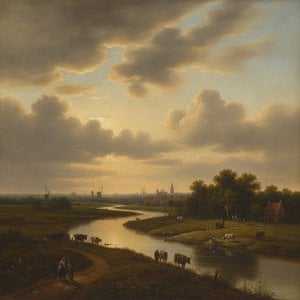
A Florid Echo of the Dutch Golden Age
Jacob van Walscapelle, a name that whispers through the corridors of the Dutch Golden Age, remains one of the era's most delicate chroniclers of nature’s fleeting splendor. Born in 1644 in Dordrecht, his life and artistry were deeply intertwined with the vibrant botanical traditions of the Netherlands. While history often places him in the shadow of more thunderous masters, Walscapelle carved out a space for himself through an almost obsessive devotion to the minute details of the natural world. He was not merely a painter of flowers, but a poet of petals, capturing the ephemeral pulse of life within the stillness of his compositions.
The foundations of his talent were laid during his formative years as an apprentice under the esteemed Cornelis Kick between 1664 and 1667. This period was far more than a simple education in technique; it was an immersion into a living laboratory of color and form. As Kick maintained an expansive garden—a sanctuary for botanical study—Walscapelle learned to observe the subtle shifts in light upon a leaf and the velvet texture of a blooming rose. When the expansion of Amsterdam necessitated the relocation of Kick’s garden to the polder of Diemermeer, Walscapelle followed, ensuring that his early training was steeped in the direct observation of living specimens rather than mere imitation of prints.
Mastery of Light and Botanical Precision
To gaze upon a Walscapelle masterpiece is to enter a world where time has momentarily ceased its march. His style, profoundly indebted to the legendary Jan Davidsz de Heem, utilizes a luminous color palette and a dramatic use of chiaroscuro to breathe life into his subjects. He possessed a rare ability to render textures so convincingly that one can almost sense the dew clinging to a petal or the cool, heavy weight of a stone vase. His works often feature a complex arrangement of diverse species, sometimes gathering over a dozen distinct varieties in a single, breathtaking display.
Beyond mere botanical accuracy, Walscapelle’s work is imbued with a profound sense of atmosphere. He mastered the art of the vanitas—the subtle reminder of life's transience. In his arrangements, a perfectly bloomed peony might sit alongside a slightly wilting stem or a fallen leaf, creating a silent dialogue between peak vitality and inevitable decay. This tension between the permanent—represented by sturdy vessels or heavy drapery—and the ephemeral nature of the blossoms creates an emotional resonance that transcends simple decoration, inviting the viewer to contemplate the very essence of existence.
Legacy and Artistic Significance
Though his name is occasionally obscured by the greatness of his contemporaries, Walscapelle’s influence and contribution to the genre of floral still life are undeniable. His meticulous approach served as a bridge between the expansive, exuberant styles of the mid-17th century and the more refined, delicate sensibilities that followed. His technical prowess was such that many of his works were historically confused with those of his mentor, Cornelis Kick, a testament to the seamless quality of his execution.
The historical significance of Jacob van Walscapelle lies in his ability to capture the soul of the Dutch landscape within the confines of a studio setting. His legacy is preserved in:
- Technical Excellence: The perfection of botanical rendering and light manipulation that defined the high standard of Dutch still life.
- Symbolic Depth: The sophisticated use of floral arrangements to communicate complex themes of beauty, mortality, and the passage of time.
- Artistic Continuity: His role in maintaining and evolving the traditions established by masters like de Heem and Kick, ensuring the vitality of the genre for future generations.
Spørgsmål og svar
Hvordan er Jacob van Walscapelles karriere opdelt i perioder?
Jacob van Walscapelles karriere udfolder sig periode for periode på kunstnerens Kronologi-side: en horisontal tidslinje over værkerne, opdelt i kapitler efter karriereperioder.
Hvor kan jeg se alle værker af Jacob van Walscapelle?
Se alle værker af Jacob van Walscapelle på denne hjemmeside på kunstnerens Alle kunstværker-side.
Hvor kan jeg se Jacob van Walscapelles værker opdelt efter stemning?
På kunstnerens Stemningsfulde rum side kan du finde Jacob van Walscapelles værker sorteret efter stemning.