A Legacy of Form and Spirit
The artistic journey of Irmgard Sörensen-Popitz is a profound exploration of the intersection between geometric precision and emotional depth. Emerging from the vibrant German art scene, her work serves as a bridge between the structured discipline of early twentieth-century modernism and the expressive freedom of mid-century abstraction. Her aesthetic language, deeply rooted in the principles of Bauhaus design, emphasizes simplicity, functionality, and a meticulous attention to geometric form. Through her diverse repertoire—ranging from graphic posters to evocative mixed-media pieces—she captured the shifting zeitgeist of a century marked by both social upheaval and artistic revolution.
In her early endeavors, one finds a striking echo of Constructivism and the Bauhaus movement. Her 1930 poster for Bode Gymnastik stands as a testament to this period, utilizing a monochrome palette and orthogonal lines to convey strength and athletic grace. This work reflects a mastery of light and shadow, where the rigidity of straight horizontal and vertical lines meets the dynamic energy of human movement. Such pieces demonstrate her ability to utilize rational organization and structural harmony to communicate ideas with clarity and impact, mirroring the influential visual culture of the Weimar Republic.
The Evolution of Abstraction and Symbolism
As her career progressed, Sörensen-Popitz moved beyond the starker confines of graphic design into a more luminous and spontaneous realm of abstraction. Her later works, such as the 1957 painting Magical Game, reveal an artist captivated by the interplay of color and emotion. In these compositions, the canvas becomes a radiant stage where sun-drenched yellows and rhythmic purple accents dance across the surface. This period of her work suggests a liberation from strict structure, allowing for a sensory experience where geometry and feeling collide in a joyful, chromatic play.
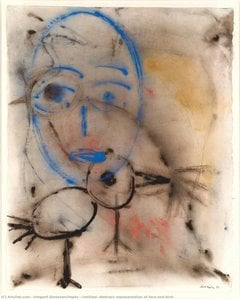
Beyond pure abstraction, Sörensen-Popitz also delved into deeply symbolic territories, blending the human element with the natural world. Her mixed-media explorations, including her 1970 work Untitled (Abstract representation of face and bird), showcase a sophisticated mastery of texture and materiality. In these pieces, she invites the viewer into an intimate dialogue between the soul and nature, using striking blue eyes and delicate avian imagery to explore themes of connection, solitude, and the wild freedom of the spirit. Her ability to layer paint and texture creates a tactile quality that breathes life into her subjects, making her work both intellectually stimulating and emotionally resonant.
Historical Significance and Recognition
The enduring relevance of Irmgard Sörensen-Popitz is preserved through her association with some of the most significant institutions of modern art. Her contributions to the visual language of German modernism have earned her a place in prestigious collections, notably within the Bauhaus Foundation Dessau. This recognition underscores her role not merely as a participant in the era's great movements, but as an artist who successfully synthesized the disciplined aesthetics of design with the profound mysteries of abstract expression.
Her artistic legacy is characterized by several key elements:
- Design Mastery: A foundational connection to the Bauhaus and Constructivist traditions, emphasizing clarity and form.
- Versatility of Medium: An ability to transition seamlessly from monochrome graphic posters to complex, textured mixed-media works.
- Emotional Depth: The capacity to use geometric shapes and vibrant palettes to evoke spontaneous joy and spiritual contemplation.
- Institutional Legacy: A lasting impact on the history of German modernism, recognized by major foundations.
Spørgsmål og svar
Findes der en kronologisk gennemgang af Irmgard Sörensen-Popitz?
En kronologisk gennemgang af Irmgard Sörensen-Popitzs værker er tilgængelig på kunstnerens Kronologi-side, hvor værkerne præsenteres i rækkefølge efter deres skabelse, kapitel for kapitel.
Kan jeg besøge et virtuelt museum med Irmgard Sörensen-Popitzs værker?
Irmgard Sörensen-Popitzs værker kan opleves i et 3D-galleri på kunstnerens 3D-galleri-side.
Kan jeg gennemse Irmgard Sörensen-Popitzs værker efter medie?
For at finde alle værker af Irmgard Sörensen-Popitz inden for et bestemt medie, kan du bruge kunstnerens Alle medier side.