The Soul Behind the Canvas: The Life of Hugo von Habermann
In the grand tapestry of late nineteenth-century German art, few threads are as intricately woven with both aristocratic grace and revolutionary spirit as those belonging to Hugo Joseph Anton Freiherr von Habermann. Born in 1849 into a world of privilege in Dillingen and later shaped by the vibrant intellectual atmosphere of Munich, Habermann was a man caught between two eras. While his lineage suggested a life of legal scholarship and social standing, his heart belonged to the transformative power of the brush. His early years were marked by a decisive departure from the predictable path of law, a choice spurred by the profound experiences he encountered during the Franco-Prussian War. Serving as an officer, he did not merely witness the tumult of conflict; he found his true calling amidst the shadows of war, even overseeing the documentation of prisoners in Ingolstadt, which solidified his commitment to the life of a painter.
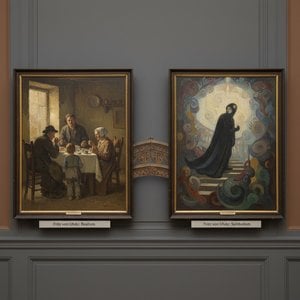
The evolution of Habermann’s technique was deeply rooted in the rigorous academic traditions of Munich. Under the mentorship of luminaries such as Hermann Schneider and the legendary Karl Theodor von Piloty, he mastered the ability to render form with precision and light with a poetic touch. Yet, Habermann was never content to remain a mere student of tradition. He possessed an innate drive to push beyond the boundaries of academic realism, seeking instead to capture the psychological depth and symbolic resonance that defined the burgeoning Secession movement. Alongside contemporaries like Bruno Piglhein and Fritz von Uhde, he became a pivotal figure in Allotria, a radical group of artists dedicated to breaking free from the stifling conventions of the old guard. This rebellious streak eventually led him to become a co-founder and the second President of the Munich Secession, marking his place as a leader of the avant-garde.
A Legacy of Portraits and Symbolism
As his career matured, Habermann’s work began to reflect a profound engagement with Symbolism, moving away from literal representation toward an exploration of the human psyche. He became particularly renowned for his evocative portraits, especially those of women, which were characterized by an ethereal quality and a delicate handling of emotion. His ability to imbue his subjects with a sense of mystery and interiority made him a master of the genre. This mastery was not merely recognized by his peers but also by the highest echelons of Bavarian society; in 1897, the Prince Regent Luitpold bestowed upon him the title of Royal Bavarian Professor following the profound impact of his painting Salomé.
The significance of Habermann’s contribution to art history lies in his ability to bridge the gap between the classical and the modern. His work serves as a vital link between the structured realism of the mid-century and the expressive, often dreamlike explorations of the turn of the century. To look upon a Habermann portrait is to encounter more than just a likeness; it is to witness a carefully constructed dialogue between light, shadow, and the unseen depths of the human spirit. His life remains a testament to the courage required to abandon certainty for the sake of artistic truth, leaving behind a legacy that continues to resonate within the halls of German art history.