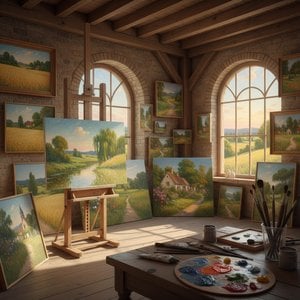
Hubert Lindsay Wellington: Painter of Tranquil English Landscapes
Hubert Lindsay Wellington (1879 – 1967) was a British Impressionist painter whose serene depictions of Staffordshire landscapes captured the essence of rural England during the early 20th century. Born in Frampton Mansell, Worcestershire, Wellington’s artistic journey began with an interest in drawing and sketching from a young age, nurtured by his father, who instilled in him a deep appreciation for the natural world. Despite facing challenges typical of artists striving to establish themselves amidst the burgeoning modernist movement, Wellington persevered, developing a distinctive style characterized by loose brushstrokes, vibrant color palettes, and a masterful manipulation of light—elements that would become hallmarks of his oeuvre.- Early Life & Artistic Beginnings: Wellington’s formative years were marked by a profound connection to the Worcestershire countryside. He honed his skills through self-study and experimentation, absorbing influences from Impressionist luminaries like Claude Monet and Pierre Renoir. These artists championed capturing fleeting moments of beauty—the dappled sunlight filtering through leaves, the misty mornings over rolling hills—a philosophy that profoundly shaped Wellington’s artistic vision.
- The Influence of Staffordshire: Staffordshire, Wellington's chosen subject matter, served as a constant source of inspiration. The region’s picturesque landscapes – expansive meadows dotted with wildflowers, ancient woodlands bathed in golden light—provided him with an endless canvas for exploring the subtleties of color and texture. He meticulously observed the changing seasons, striving to convey not merely what he saw but also how it felt—the warmth of summer afternoons, the crispness of autumn mornings.
- Technique & Style: Wellington’s technique was rooted in Impressionistic principles. He employed thick impasto – applying paint thickly onto the canvas – creating palpable textural surfaces that mirrored the rugged beauty of Staffordshire's terrain. His brushstrokes were loose and expressive, prioritizing capturing atmospheric conditions over precise representation. Color palettes leaned towards muted hues—greens, browns, blues—reflecting the subdued tones of rural landscapes. However, Wellington skillfully punctuated these harmonies with bursts of vibrant color, particularly yellows and reds, highlighting key focal points within his compositions.
- Notable Works & Recognition: Among Wellington’s most celebrated paintings are “Lane to Walton” and “Overhanging Tree,” both executed in 1915. These canvases exemplify his mastery of Impressionistic technique and capture the sublime grandeur of Staffordshire's scenery. They reside in prestigious collections, testament to their enduring artistic merit.
- Legacy & Historical Significance: Wellington’s contribution to British Impressionism lies in his unwavering commitment to portraying the beauty of the English countryside with sensitivity and nuance. He stands as a beacon of pastoral idealism—a reminder that art can elevate our understanding of nature and inspire contemplation on its profound impact on human experience. His paintings continue to resonate with viewers today, offering glimpses into a bygone era while simultaneously affirming the timeless allure of landscapes rendered with luminous color and evocative brushwork.