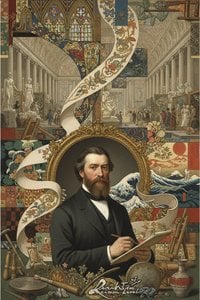
Henri Magron: A Pioneer of Photographic Illustration
Born in Caen, France, in 1845, Henri Magron’s life was a testament to the burgeoning possibilities of photography during a period when the medium was still finding its footing. While not a household name today, Magron deserves recognition as one of the earliest and most innovative figures in French photographic illustration – a crucial bridge between the nascent art form and the rise of illustrated books. His career spanned several decades, marked by a dedication to capturing the beauty of Normandy and experimenting with techniques that anticipated later developments in image-making.
Magron’s early artistic training began under the tutelage of Edmond Bacot and Frédéric Barjot, skilled photographers who instilled in him a foundational understanding of the craft. This initial guidance proved invaluable as he embarked on his own photographic journey. Unlike many of his contemporaries focused solely on portraiture or landscape, Magron quickly recognized the potential of photography to visually narrate stories within printed media. He wasn’t simply documenting; he was actively shaping and directing the image to serve a specific purpose – to enhance and illuminate written text.
Early Innovations in Photographic Illustration
Magron's most significant contribution lies in his pioneering work illustrating books with photographs. In 1889, he meticulously crafted images for Alphonse Daudet’s ‘L’Élixir du Révérend Père Gaucher,’ a landmark publication that demonstrated the power of photographic illustration to create atmosphere and deepen the reader's experience. This wasn’t merely pasting in pre-existing photographs; Magron carefully staged scenes, manipulated lighting, and employed techniques like dodging and burning to achieve specific effects – a level of artistic control rarely seen at the time. His work went beyond simple reproduction; he used photography as a tool for storytelling, creating mood and character.
Further solidifying his reputation was his involvement in ‘La Normandie Monumentale et Pittoresque,’ a comprehensive survey of Normandy’s history and landscapes. This ambitious project showcased Magron's ability to capture the region’s diverse beauty – from its dramatic coastlines to its charming villages. He wasn’t just recording; he was presenting a carefully curated vision of Normandy, utilizing photographic techniques to evoke a sense of place and time.
Membership and Legacy within the Photographic Community
Magron's dedication to photography extended beyond commercial projects. He was an active member of the Société Caennaise de Photographie, a prominent organization dedicated to promoting the art form in Caen. This engagement highlights his commitment to fostering a community of photographers and sharing knowledge.
In 1911, seeking respite from the demands of his career, Magron retired to Dives-sur-Mer. He passed away on January 15, 1927, at the age of 82, leaving behind a legacy as one of France’s earliest and most influential photographic illustrators. While he may not be widely celebrated today, his work remains a valuable testament to the creative potential of photography in the late 19th century – a period when it was still evolving from a technical curiosity into a powerful artistic medium.
Notable Works & Techniques
- ‘L’Élixir du Révérend Père Gaucher’ (1889): This publication is considered Magron's most significant achievement, demonstrating his ability to use photography to enhance narrative and create atmosphere.
- Use of Dodging & Burning: Magron skillfully manipulated the tones of his photographs through dodging (removing light) and burning (adding light), creating dramatic contrasts and emphasizing key elements within the composition.
- Staged Scenes: He wasn’t simply capturing reality; he carefully arranged scenes to achieve a desired visual effect, demonstrating an understanding of composition and storytelling.
Historical Context & Significance
Magron's work emerged during a period of rapid technological advancement in photography. The development of dry plate photography made the process more accessible, while advancements in lens technology allowed for sharper images with greater detail. However, Magron’s contribution lies not just in utilizing these new tools but in pushing the boundaries of what was considered possible with photographic illustration. He demonstrated that photography could be used to create artful and evocative images within printed media – a concept that would profoundly influence subsequent generations of illustrators and artists.