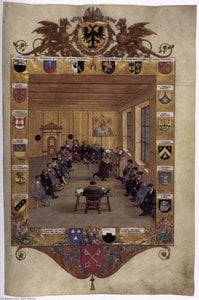
Hans Muelich: A Munich Master of Portraiture and Allegory
Born in Munich in 1516, Hans Muelich (also known as Mielich) was a pivotal figure in the artistic landscape of Renaissance Germany. His life spanned a period of significant cultural transformation, witnessing the rise of humanism and the burgeoning influence of Italian art on Northern Europe. Muelich’s career unfolded across Bavaria, from his formative years studying under Barthel Beham to his later work as a court painter for the powerful Duke Albert V, leaving behind a legacy of meticulously rendered portraits and evocative historical allegories.
Muelich's early artistic development was deeply rooted in Munich. As the son of Wolfgang Muelich, a respected city painter, he inherited not only a profession but also a workshop steeped in tradition. His training with Beham, a master known for his detailed landscapes and realistic depictions of figures, provided him with a solid foundation in technique. However, it was his time in Regensburg between 1536 and 1539 that proved transformative. There, he encountered Albrecht Altdorfer, whose dynamic compositions, vibrant color palettes, and dramatic use of light profoundly impacted Muelich’s artistic sensibilities. This encounter marked a shift towards a more expressive and emotionally charged style, evident in his later works.
A crucial chapter in Muelich's career unfolded during his journey to Rome in 1541. This pilgrimage allowed him to immerse himself in the heart of the Renaissance, absorbing the innovations of masters like Michelangelo and Raphael. He returned to Munich in 1543, a changed artist, and quickly gained recognition as a master painter within the city’s burgeoning artistic community, becoming a member of the prestigious Painter's Guild. His return coincided with a period of significant patronage from Duke Albert V, who commissioned numerous works, including the famed “Jewel Book of the Duchess Anna of Bavaria,” a lavish manuscript containing 110 exquisite drawings – a testament to Muelich’s skill and meticulous attention to detail.
The Jewel Book: A Window into Bavarian Royalty
The "Kleinodienbuch der Herzogin Anna von Bayern" (Jewel Book of the Duchess Anna of Bavaria) stands as arguably Muelich's most celebrated achievement. Commissioned in 1552, this intricate manuscript showcases his unparalleled ability to render precious objects with astonishing realism and elegance. Each drawing is a miniature masterpiece, capturing the shimmering surfaces of jewels, the delicate textures of fabrics, and the subtle nuances of light and shadow. The book’s creation demanded not only technical proficiency but also an acute understanding of materials and their reflective qualities – skills Muelich masterfully employed.
Beyond its aesthetic value, the Jewel Book offers a fascinating glimpse into the opulent lifestyle of Duchess Anna and her husband, Albert V. The detailed depictions of their jewelry collection reveal the extent of their wealth and influence, while also providing valuable insights into the fashion trends and artistic tastes of the era. The book is now housed in the Bavarian State Library, serving as a tangible link to a bygone age.
Portraits of Munich’s Elite
While renowned for his manuscript illuminations, Muelich was equally accomplished as a portrait painter. He produced numerous portraits of leading members of Munich's patrician class – wealthy merchants, officials, and nobles – capturing their individual personalities and social standing with remarkable accuracy. These portraits are characterized by their dignified composure, subtle expressions, and meticulously rendered clothing and accessories.
Notable examples include portraits of prominent figures like the Duke himself and his wife, Anne of Austria, now housed in the Kunsthistorisches Museum in Vienna. Muelich’s ability to convey both physical likeness and psychological depth made him a highly sought-after portraitist within Munich's elite circles. His portraits are not merely representations of individuals; they are carefully constructed narratives that reveal their status, character, and aspirations.
Religious Works and the Ingolstadt Altar
Muelich’s artistic output extended beyond secular commissions to encompass a significant body of religious works. He created altarpieces, votive paintings, and depictions of biblical scenes for churches throughout Bavaria, particularly in Ingolstadt. His religious paintings reflect the prevailing Counter-Reformation aesthetic – characterized by emotional intensity, dramatic composition, and a focus on conveying moral messages.
His most ambitious religious undertaking was the “Ingolstadt Altar,” completed between 1560 and 1572. This monumental altarpiece, now housed in the Frauenkirche (Church of Our Lady) in Ingolstadt, is a complex and richly detailed depiction of the Passion of Christ. It showcases Muelich’s mastery of color, composition, and narrative storytelling – elements that cemented his reputation as one of Bavaria's leading religious painters.
Legacy and Influence
Hans Muelich died in Munich in 1573, leaving behind a substantial body of work that continues to captivate art historians and collectors today. His influence can be seen in the works of subsequent generations of Bavarian artists, particularly Albrecht Altdorfer, with whom he shared a close artistic relationship. Muelich’s meticulous technique, expressive style, and ability to capture both the beauty and complexity of human experience have ensured his place as one of the most important figures in German Renaissance art.
His legacy is preserved through numerous surviving paintings, drawings, and illuminated manuscripts – each a testament to his skill, creativity, and enduring contribution to the artistic heritage of Bavaria. The “Jewel Book of the Duchess Anna of Bavaria” remains a particularly prized example of his work, offering a rare and intimate glimpse into the world of Bavarian royalty in the 16th century.