A Pioneer of Cubism in Turkey: The Life and Art of Hale Salih
Hale Asaf, born Hale Salih in 1905 in the vibrant Kadıköy district of Istanbul, stands as a pivotal figure in the modernization of Turkish painting. Her story is one of artistic courage, navigating societal expectations and embracing avant-garde movements at a time when Turkey was undergoing profound transformation. Unlike many of her contemporaries who found inspiration in Impressionism or traditional academic styles, Salih became a dedicated proponent of Cubism, leaving an indelible mark on the early 20th-century Turkish art scene with her striking self-portraits, portraits and still lifes.
Early Life and Artistic Foundations
Born into a prominent Ottoman family—her father was Salih Bey, a chief judge, and her mother Enise Hanım—Hale Asaf’s upbringing was steeped in privilege yet progressive ideals. Her lineage included notable figures like her grandfather Rasim Pasha, head of the Imperial Medical School, and even traced back to Halil Hamid Pasha, a Grand Vizier of Georgian origin. This rich heritage instilled in her a cosmopolitan outlook that would later inform her artistic choices. A childhood illness necessitated surgery at age five, leaving lasting health complications, but it did not diminish her spirit or burgeoning creativity. She received a solid education, mastering English, French and Italian alongside Turkish, setting the stage for her international pursuits.
Salih’s formal art journey began in 1919 with lessons from her aunt, Mihri Müşfik Hanım, Turkey's first female artist, during a stay in Rome. This early mentorship proved crucial, providing a foundation and encouragement to explore her artistic inclinations. Further studies followed in Paris under Namık İsmail, exposing her to the heart of the European art world. However, it was her time at the Prussian Academy of Fine Arts in Berlin (1921-1924) that marked a turning point, where she studied with Arthur Kampf and encountered fellow artist Fikret Mualla.
Embracing Cubism and Defining a Unique Style
Upon returning to Turkey in 1924, Salih enrolled at the Academy of Fine Arts for Women, studying under Feyhaman Duran and later İbrahim Çallı. However, her artistic vision soon diverged from the prevailing academic norms. She secured a scholarship to study in Europe once more, this time briefly attending the Academy of Fine Arts in Munich with Lovis Corinth before returning to Paris in 1927. It was at the Académie de la Grande Chaumière under André Lhote that she fully embraced Cubism.
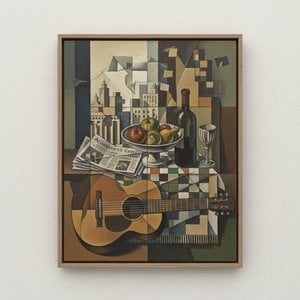
Salih’s adoption of Cubism wasn't merely a stylistic choice; it represented a bold departure from tradition and a desire to express a new, modern sensibility. Her self-portraits are particularly compelling examples of this influence, characterized by fragmented forms, geometric shapes, and a nuanced exploration of identity. She didn’t simply replicate the techniques of Picasso or Braque but infused them with her own unique perspective, reflecting both Turkish cultural influences and her personal experiences.
Activism, Collaboration, and Legacy
Returning to Turkey in 1928, Salih became a painting instructor at the Bursa Teacher Training School for Girls. She was a key figure in establishing the Association of Independent Painters and Sculptors in 1929—a groundbreaking collective that challenged established artistic conventions. This association provided a platform for progressive artists to exhibit their work and fostered a spirit of experimentation.
Despite facing societal challenges and personal hardships – including her parents’ separation and ongoing health issues – Salih remained committed to her art. She participated in exhibitions both in Turkey and Paris, showcasing her distinctive style to an increasingly receptive audience. Her works often explored themes of introspection, modernity, and the female experience.
Sadly, Hale Asaf's life was cut short in 1938 at the age of 33, in Paris. World War II led to the loss of some of her artworks, and many others remained undocumented in private collections for decades. Today, fewer than thirty of her works are known to exist, making each piece a precious testament to her artistic vision. Hale Salih’s legacy endures as a pioneering figure who dared to challenge conventions, embrace innovation, and pave the way for future generations of Turkish artists.
Major Achievements & Historical Significance
- Pioneering Cubism in Turkey: She was among the first Turkish artists to fully adopt and develop a Cubist style, introducing a new aesthetic vocabulary to the local art scene.
- Founding Member of the Independent Painters and Sculptors Association: Her role in establishing this collective was instrumental in fostering artistic freedom and experimentation.
- International Exposure: Exhibiting her work in both Turkey and Paris helped to bridge cultural divides and introduce Turkish art to a wider audience.
- Breaking Gender Barriers: As one of the first female artists in Turkey, she challenged societal norms and inspired other women to pursue their artistic passions.
- Unique Artistic Voice: She blended Cubist techniques with her own cultural background and personal experiences, creating a distinctive style that continues to captivate viewers today.
Hale Asaf’s story is not just about an artist; it's about the courage to forge one’s own path in a rapidly changing world. Her work remains a powerful reminder of the importance of artistic innovation, cultural exchange, and the enduring legacy of those who dare to challenge the status quo.