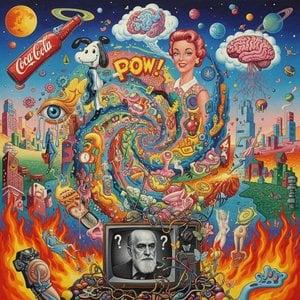
Gary Simmons Jr.: The Ghostly Echoes of American Culture
Gary Simmons Jr., born April 14, 1964 in New York City, is an American artist whose distinctive approach to painting and sculpture has garnered critical acclaim for its exploration of race, class, and cultural stereotypes. His groundbreaking technique—the “erasure drawing”—has cemented his place as a pivotal figure in contemporary art, transforming familiar images into haunting representations that grapple with the complexities of memory and history.
### Early Influences & Artistic Formation
Simmons’s artistic journey began at the School of Visual Arts in 1988 where he earned his BFA, followed by an MFA from CalArts in 1990 under the mentorship of influential artists like Charles Gaines, Michael Asher, and Catherine Lord. These formative experiences instilled in him a fascination with conceptual art and a commitment to interrogating societal narratives—a dedication that would become central to his artistic practice. Notably, Simmons’s studio space was initially occupied by former vocational school classrooms, sparking an interest in the materiality of education and its role in shaping identity.
### The Erasure Technique: A Poetic Response to Image Permanence
Simmons's signature method—the erasure drawing—represents a radical departure from traditional painting techniques. He begins by applying white chalk or oil paint onto slate-colored panels or canvases, meticulously recreating iconic images from American popular culture—cartoons, film stills, advertisements—often referencing minstrel stereotypes prevalent in the 1930s and 40s. Crucially, he then smudges the surface with his hands, deliberately obscuring the original image and leaving behind ghostly traces of pigment. This process isn’t merely accidental; it's a deliberate act of negation designed to confront the permanence of visual representations and to evoke the elusive nature of memory. As Simmons eloquently describes, “I started to think about how images on blackboards can never be fully erased. It was about trying to erase a stereotype and the traces of the racial pain that you drag along with you.” This technique speaks to the impossibility of forgetting and acknowledges the enduring legacy of historical injustices.
### Landmark Projects & Critical Recognition
Simmons’s work has achieved considerable recognition through prestigious commissions and exhibitions, including “Wall of Eyes” for the Whitney Biennial in 1993—a monumental slate painting featuring a field of cartoon eyes—and “Sky Erasure Drawings,” commissioned by the Museum of Contemporary Art Chicago in 1996. He further expanded his artistic scope with immersive installations like “Fade to Black” for the California African American Museum in 2017, exploring themes of surveillance and memory through architectural environments. His exploration of music—particularly dub, punk, hip-hop, reggae, and rap—has informed his practice, reflecting a deep engagement with cultural dialogues surrounding race and class. Simmons’s work has been lauded for its conceptual rigor, its evocative materiality, and its ability to provoke profound reflection on social issues.
### Continuing Legacy & Artistic Exploration
Gary Simmons continues to push the boundaries of artistic expression, experimenting with new mediums and engaging in ongoing collaborations. His recent projects delve into architectural spaces and explore the interplay between history and performance, demonstrating a sustained commitment to interrogating cultural narratives and confronting uncomfortable truths. Simmons’s erasure drawings remain an enduring symbol of his artistic vision—a testament to the transformative power of art as a means of reclaiming memory and challenging dominant ideologies.