Early Life and Artistic Foundations
Frederick Appleyard, born in Middlesbrough on September 9th, 1874, emerged into a world dramatically reshaped by the Industrial Revolution. His father, Isaac Appleyard, was an iron merchant—a profession deeply entwined with the burgeoning landscape of Victorian England. This early exposure to both the opportunities and the stark realities of industrial progress would subtly inform his later artistic sensibilities. Appleyard’s initial education took place in Scarborough, a coastal town offering a different rhythm of life than his birthplace. It was here he began formal art training at the Scarborough School of Art under Albert Strange, a genre and landscape painter who instilled foundational skills and an appreciation for representational form. A lifelong friendship blossomed with fellow student Harry Watson during this period, providing mutual support and encouragement throughout their artistic journeys. In 1897, Appleyard embarked on a more rigorous path, gaining entry into the prestigious Royal Academy Schools—a significant achievement at the age of twenty-two, recommended by John Sparkes. This marked a pivotal moment, immersing him in the heart of London’s art establishment and exposing him to classical traditions and demanding academic standards. He quickly distinguished himself, earning accolades including the Turner Gold Medal for landscape painting, the Creswick Prize, and the Landseer Scholarship—testaments to his burgeoning talent and dedication.A Rising Star: Early Career and Academic Success
The early years of the 20th century saw Appleyard establish himself as a promising artist within the Royal Academy’s orbit. He secured commissions for significant mural decorations, notably adorning the walls of the Royal Academy Refreshment Room in 1903 with scenes that showcased his skill in large-scale composition and narrative storytelling. Further projects followed at St Mark's Church on North Audley Street, as well as two substantial paintings for Nottingham General Hospital and a decorative scheme for the Church of SS Peter and Paul in Pickering, Yorkshire. These commissions weren’t merely exercises in technical proficiency; they revealed Appleyard’s ability to translate complex ideas into visually compelling forms, often imbued with allegorical meaning. A period spent working in South Africa between 1910 and 1912 broadened his artistic horizons, though the precise impact of this experience on his style remains a subject for further exploration. The outbreak of World War I brought an unexpected turn, as Appleyard found himself employed at the Woolwich Arsenal—a practical contribution to the war effort that nonetheless provided a stark contrast to the refined world of art he had previously inhabited. Throughout these years, he consistently exhibited at the Royal Academy from 1900 to 1935 and maintained a presence at the Royal Watercolour Society until approximately 1950, solidifying his reputation within the British art scene.Shifting Landscapes: From Pre-Raphaelite Influence to Hampshire Impressionism
While Appleyard initially gained recognition for subject pictures, portraits, and allegorical compositions rooted in a decorative style reminiscent of English Impressionism, a profound shift occurred after World War I. He left the bustling metropolis of London and settled in the tranquil Hampshire village of Itchen Stoke—a move that would fundamentally alter his artistic trajectory. Captivated by the beauty of the surrounding countryside, particularly the chalk streams and dappled sunlight filtering through ancient trees, he embraced a more direct engagement with nature. This transition wasn’t abrupt; it was a gradual evolution driven by personal connection and a desire to capture the fleeting moments of light and atmosphere. He moved away from elaborate narratives towards a focus on rural landscapes, tender portraits bathed in soft light, and jewel-like still lifes—a style often described as British Impressionism. This later work reveals a remarkable sensitivity to color and texture, reflecting an artist deeply attuned to the nuances of his environment. The change was not merely stylistic; it represented a conscious rejection of commercial pressures and a commitment to artistic integrity.Rediscovering Appleyard: Legacy and Enduring Appeal
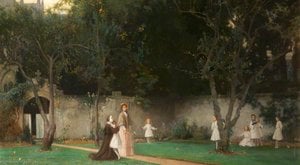
Despite achieving considerable success during his lifetime—with 41 works exhibited at the Royal Academy and representation in prominent collections including the Tate Gallery—Appleyard’s work fell into relative obscurity for many years. His painting, “A Secret,” acquired by the Chantry Bequest from the 1915 Royal Academy Exhibition, remains a testament to his earlier achievements. Works are also held at the Victoria Art Gallery in Bath, Bristol, Rochdale, and Grahamstown, South Africa, demonstrating a wider reach than often acknowledged. The painting “Old Walls” is displayed at the Mansion House in Doncaster. However, recent scholarship and exhibitions—such as the 2024 retrospective at The Arc in Winchester commemorating his 150th birthday—are actively working to reintroduce Appleyard to a contemporary audience. This renewed interest stems from an appreciation for his evocative landscapes, his masterful handling of light, and the poignant sense of tranquility that permeates his work. He is particularly known for depicting affluent families amidst picturesque ruins, often using a dappling technique to create a luminous effect. His later paintings, created in relative isolation in Hampshire, reveal a rare combination of academic skill and artistic philosophy—a testament to a life dedicated to capturing the beauty of the natural world and the fleeting moments of human connection. Appleyard’s story is one of adaptability, integrity, and a quiet pursuit of artistic excellence, making him a compelling figure in British art history. He died in Alresford, Hampshire on February 22nd, 1963, leaving behind a legacy that continues to inspire and captivate.Spørgsmål & svar
Hvilke stemninger udtrykker Frederick Appleyards kunstværker?
Kunstnerens Stemningsrum side viser Frederick Appleyards værker arrangeret efter deres atmosfære.
Kan jeg udforske Frederick Appleyards værker efter emne?
Siden Emneatlas kortlægger Frederick Appleyards kunstværker efter motiv.
Hvilke pseudonymer eller andre navne bruger Frederick Appleyard?
Frederick Appleyard er også kendt som Fred Appleyard, Frederick William Appleyard.