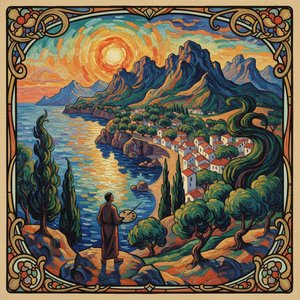
A Life Immersed in Light: The World of Francisco Arasa
Francisco Arasa (1858-1927), born Francesc Gimeno i Arasa, was a Spanish painter whose work beautifully encapsulates the spirit of late 19th and early 20th century Catalan art. While not as widely celebrated internationally as some of his contemporaries, Arasa’s evocative landscapes, particularly those depicting the rugged coastline and sun-drenched scenes of Catalonia, hold a significant place in understanding the regional artistic developments of Spain during this period. His paintings are more than mere representations; they are imbued with a sense of atmosphere, capturing the very essence of light and shadow that defines the Mediterranean landscape. Arasa’s life was deeply intertwined with his surroundings, and it is through this connection that we begin to understand the power and subtlety of his artistic vision. He wasn't simply *painting* Catalonia; he was translating its soul onto canvas.
Early Years and Artistic Formation
Arasa received his formal training at the prestigious Escola de la Llotja in Barcelona, a pivotal institution for aspiring artists in Spain. This academy provided him with a solid foundation in traditional painting techniques, emphasizing meticulous draftsmanship and realistic representation. However, Arasa’s artistic inclinations soon led him beyond strict academic adherence. He was drawn to the emerging *plein air* movement, embracing the practice of painting outdoors directly from nature. This shift marked a crucial turning point in his development, allowing him to capture the fleeting effects of light and atmosphere with greater immediacy and authenticity. The influence of Catalan luminism is palpable in his early works, characterized by soft, diffused lighting and a delicate rendering of natural forms. He wasn’t alone in this pursuit; Barcelona was becoming a hub for artists experimenting with new approaches to landscape painting, fostering an environment of creative exchange and innovation.
The Catalan Coast as Muse
Arasa's artistic focus centered on the coastal regions of Catalonia, particularly around his home near Torroella de Fluvià. He became renowned for his depictions of beaches, fishing villages, and the dramatic cliffs that line the Mediterranean Sea. His paintings from this period are characterized by a remarkable sensitivity to color and texture. The warm hues of the sand, the shimmering blues of the water, and the rugged earth tones of the landscape are rendered with exquisite detail.
His ability to capture the interplay of light on water is particularly noteworthy, creating an almost palpable sense of atmosphere. Beyond the purely aesthetic qualities, Arasa’s coastal scenes often depict everyday life – fishermen mending their nets, families enjoying a day at the beach, and bustling market scenes like his famous “Torroella Market”. These paintings offer a glimpse into the social fabric of Catalonia during this era, providing valuable insights into the lives and customs of its people.
Portraiture and Beyond
While best known for his landscapes, Arasa also produced a significant body of portrait work. His portraits are characterized by a similar attention to detail and sensitivity to light as his landscapes, but they also reveal a keen understanding of human psychology. He wasn’t interested in simply capturing physical likeness; he sought to portray the inner character and personality of his subjects.
These portraits often depict members of the Catalan bourgeoisie, reflecting his social connections and the patronage he received throughout his career. Beyond landscapes and portraiture, Arasa also experimented with genre scenes and historical paintings, demonstrating a versatility that is sometimes overlooked in discussions of his work.
Legacy and Historical Significance
Francisco Arasa’s legacy lies in his ability to capture the unique beauty and atmosphere of Catalonia through his evocative paintings. He wasn't a revolutionary artist seeking to overturn established conventions; rather, he was a master craftsman who refined traditional techniques to create works that are both visually stunning and emotionally resonant. His paintings offer a valuable window into the social and cultural life of late 19th and early 20th century Catalonia, providing insights into the lives and customs of its people.
- His work represents a significant contribution to Catalan luminism.
- He successfully blended academic training with *plein air* painting techniques.
- Arasa’s paintings continue to be celebrated for their sensitivity to light, color, and atmosphere.
Though perhaps not a household name, Francisco Arasa remains an important figure in the history of Spanish art, his canvases serving as enduring testaments to the beauty and spirit of his beloved Catalonia.