The Luminous Legacy of Francesco Cappella
Born in the vibrant, water-bound splendor of Venice in 1711, Francesco Cappella emerged as a profound voice within the twilight of the Venetian Baroque. His life and artistry were inextricably linked to an era that balanced the burgeoning rationalism of the Enlightenment with a lingering, passionate devotion to religious mysticism. Often referred to by the evocative nickname Daggiù, or sometimes simply as Il Capella, he navigated a world where light and shadow served not merely as aesthetic choices, but as spiritual conduits. His early training, deeply rooted in the prestigious workshops of his homeland, allowed him to absorb the dramatic essence of the Venetian tradition, preparing him to become a master of the sublime.
The foundation of Cappella’s technical prowess can be traced back to his formative years under the guidance of legendary masters. While some accounts link his early development to the stylistic precepts of Rome and the influence of Giuseppe Rusconi, much of his artistic identity was forged in the studio of the renowned Giovanni Battista Piazzetta. This apprenticeship was transformative; by studying under Piazzenta, Cappella learned to manipulate chiaroscuro—the dramatic interplay of light and dark—to create depth and emotional resonance. His early works often mirrored the style of his mentor, sometimes even assisting in the completion of Piazzetta’s frescoes, a period that allowed him to refine a sense of monumental scale and theatrical movement that would become his hallmark.
Mastery of Drama and Divine Intervention
As his career progressed, Cappella moved beyond mere imitation, developing a unique ability to capture the miraculous through a lens of human emotion. His oeuvre is most celebrated for its grand-scale religious compositions, particularly those designed to adorn the sacred spaces of Italian churches. He possessed a rare talent for tenebrism, utilizing deep, velvety shadows to thrust his subjects into the light, creating a sense of sudden, divine presence. This technique was never purely decorative; it served to heighten the tension between the earthly and the divine, making the miraculous feel tangibly present to the viewer.
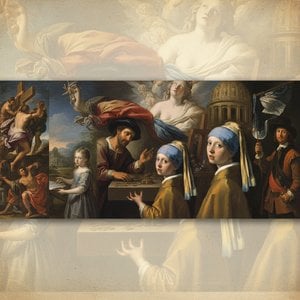
One of his most enduring masterpieces, the Miracle of San Francesco da Paola, serves as a perfect window into his creative soul. Painted around 1750, this work showcases his ability to orchestrate complex human drama within a single frame. In it, the saint intervenes to save a mason from a fatal fall, a moment captured with such dynamic energy and luminous detail that the viewer is drawn into the very heart of the miracle. Through the use of rich pigments—predominantly warm golds and deep reds—Cappella imbued his canvases with an atmosphere that was simultaneously majestic and intimately human, reflecting a humanist approach to religious iconography that sought to connect the majesty of God with the palpable feelings of man.
Historical Significance and Enduring Influence
The trajectory of Francesco Cappella’s life took him from the canals of Venice to the significant artistic hubs of Bergamo, where he found steady employment by both the state and the church. His ability to paint history and religious narratives with such profound gravity earned him a respected place among the 18th-century Italian masters. Even as artistic tastes began to shift toward the lighter, more delicate Rococo style, Cappella remained a steadfast guardian of the Baroque's emotional intensity, ensuring that the tradition of dramatic storytelling through light remained vital.
Today, the legacy of Francesco Cappella resides in the silent, powerful presence of his works in museums and sacred basilicas across Italy. He remains a pivotal figure for those studying the evolution of Venetian painting, representing a bridge between the intense shadows of the 17th century and the more structured compositions of the late 18th century. His contribution to art lies not just in the beauty of his brushwork, but in his ability to use the medium of oil on canvas to explore the profound mysteries of faith, making the ephemeral moment of a miracle feel eternal.
Spørgsmål & svar
Hvor kan jeg se Francesco Cappellas kunstværker i et 3D-galleri?
3D-museum for Francesco Cappella er en side, der fremviser kunstnerens værker i et virtuelt tredimensionelt galleri.
I hvilke kunstretninger arbejdede Francesco Cappella?
Francesco Cappellas værker kan gennemses efter stilart på kunstnerens Alle ismer side.
I hvilken historisk periode arbejdede Francesco Cappella?
Francesco Cappella arbejdede i Early Modern-perioden. Perioden placerer kunstnerens virke i historien.