Louis Le Nain: A Master of Quiet Dignity
Louis Le Nain (c. 1593 – 1648) stands as a pivotal figure in the history of Dutch painting, a master whose influence resonates through generations of artists. Born into a family of painters in Laon, France, he ultimately established himself as one of the most celebrated members of the renowned Le Nain workshop—a collective of brothers who profoundly shaped the visual landscape of 17th-century Amsterdam. While often overshadowed by his more flamboyant siblings Antoine and Mathieu, Louis’s work possesses a quiet dignity, an understated realism, and a remarkable ability to capture the essence of human experience that has secured his enduring legacy. His paintings are not grand narratives or dramatic displays; instead, they offer intimate glimpses into everyday life—peasants at their labors, families gathered around a table, moments of simple contemplation.
The Le Nain brothers’ origins remain somewhat shrouded in mystery, though it is now widely accepted that they were born around 1600, allowing them to develop their artistic skills concurrently. Antoine and Mathieu were apprenticed to the painter Jean-Baptiste Dubois in Laon, while Louis likely began his training with the same master or perhaps a related figure. The brothers’ move to Paris in the early 1630s marked a significant shift in their careers. They quickly gained recognition for their distinctive style—characterized by muted colors, loose brushwork, and a remarkable sensitivity to light and shadow. This approach, heavily influenced by the work of artists like Rembrandt and Caravaggio, distinguished them from the more polished styles prevalent at the time. Notably, they were among the first members of the Académie Royale de Peinture et de Sculpture in 1648, just two months before Antoine and Louis tragically succumbed to illness within days of each other—a poignant loss for the artistic community.
The Le Nain Style: Realism and Atmosphere
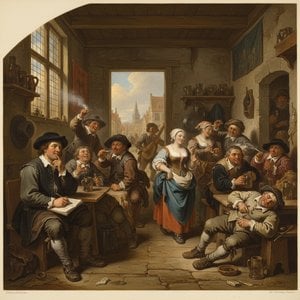
Louis Le Nain’s paintings are immediately recognizable by their distinctive style, a synthesis of observation, technique, and emotional depth. He eschewed the idealized forms and dramatic compositions favored by many of his contemporaries, instead opting for a more grounded approach that reflected the realities of peasant life. His figures are often depicted in simple clothing, engaged in mundane tasks—threshing grain, tending to livestock, or preparing food. Crucially, Le Nain wasn’t simply documenting these scenes; he was imbuing them with a profound sense of humanity. He captured not just the outward appearance of his subjects but also their inner lives—their weariness, their resilience, and their quiet dignity.
A key element of Le Nain's style is his masterful use of light and shadow. He employed a technique known as *chiaroscuro*, creating dramatic contrasts between dark and light to heighten the emotional impact of his scenes. This wasn’t merely an aesthetic choice; it served to draw the viewer’s eye to specific details, emphasizing the textures of clothing, the contours of faces, and the subtle nuances of expression. His brushwork is loose and expressive, conveying a sense of immediacy and spontaneity. The paintings often appear unfinished, as if captured in the midst of creation—a deliberate choice that contributes to their intimate and engaging quality.
Key Works and Influences
While many works attributed to the Le Nain brothers remain subjects of scholarly debate due to the difficulty in definitively assigning them to individual hands, several paintings are widely recognized as being by Louis himself. *The Peasant Family* (circa 1635-1640), housed in the Louvre Museum, is perhaps his most celebrated work—a poignant depiction of a family huddled together for warmth and comfort. The figures’ faces are rendered with remarkable sensitivity, conveying a sense of shared hardship and mutual affection. Similarly, *The Shepherdess* (circa 1638-1640), also in the Louvre, showcases Le Nain's ability to capture the beauty of nature and the quiet dignity of rural life.
Le Nain’s artistic development was undoubtedly influenced by a number of key figures. The work of Rembrandt van Rijn, with his masterful use of light and shadow and his profound understanding of human psychology, played a significant role in shaping his style. The influence of Caravaggio is also evident in Le Nain's dramatic compositions and his skillful rendering of tenebrism—the technique of using strong contrasts between light and dark to create a sense of drama and intensity. The work of the Flemish masters, particularly their emphasis on realism and atmospheric perspective, likely contributed to his distinctive approach.
Historical Significance and Legacy
Louis Le Nain’s contribution to Dutch painting is profound. He helped to establish a new standard for genre painting—a genre that would become increasingly popular in the 17th century. His paintings offer a valuable insight into the lives of ordinary people during a period of great social and economic change. Furthermore, his work demonstrated that beauty could be found not only in grand narratives and idealized forms but also in the simple realities of everyday life.
Despite being often overshadowed by his more flamboyant brothers, Louis Le Nain’s influence on subsequent generations of artists is undeniable. His quiet dignity, understated realism, and masterful use of light and shadow continue to inspire admiration and study today. He remains a testament to the power of observation, sensitivity, and artistic skill—a true master of his craft.