Faramarz Pilaram: Pioneer of Iranian Modernism
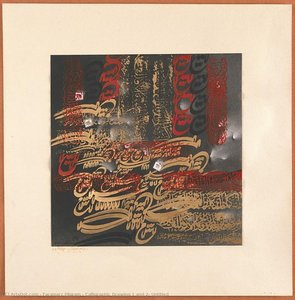
Faramarz Pilaram (persian: فرامرز پیلارام; 1937–1983, or 1982) was an iranian painter and educator. He is known for his abstract, calligraphy-based modern paintings—a distinctive contribution to Iranian art history that cemented his place as one of the founders of the Saqqakhaneh school. This movement sought to revitalize traditional Persian aesthetics through innovative visual language, reflecting a profound engagement with Iran’s cultural heritage and mythology. Pilaram's artistic journey spanned three distinct periods: initial explorations in figurative representation, followed by decorative compositions infused with geometric patterns, culminating in a deeply expressive style centered on calligraphy—a testament to his unwavering dedication to the art form itself.
Early Life and Education
Born April 10, 1937, in Tehran, Pilaram’s formative years were shaped by the influence of Jalil Ziapour's School of Decorative Arts for Boys (Honarestān-e honarhā-ye zibā-ye pesarān)*,* where he honed his skills under Mahmoud Farshchian and Shokouh Riazi. This early exposure to traditional miniature painting instilled in him a foundational understanding of Persian artistic conventions—a knowledge that would later inform his groundbreaking approach to abstraction. Pilaram graduated from Tehran University’s Faculty of Decorative Arts in 1965 with a master's degree, furthering his academic pursuits and solidifying his commitment to artistic excellence. His studies at Elm-o-san-at University culminated in a professorship role in 1972 where he continued to inspire generations of aspiring artists.
The Saqqakhaneh School and Artistic Influences
Pilaram’s pivotal contribution to Iranian art came with the establishment of Iran Gallery (Tālār-e iran, later talar-e ghandriz) in 1964—a collaborative venture with Mansoor Ghandriz, Rouin Pakbaz, Sadeq Tabrizi, Mohammad-reza Jodat, Ghobad Shiva, Massoud Arabshahi, Sirus Malek, Farshid Mesghali, Parviz Mahallati, Morteza Momayez, and Hadi Hezarei. This gallery served as a catalyst for fostering dialogue between Iranian artists and international audiences—a crucial step in elevating Iran’s artistic profile on the global stage. Alongside this institutional role, Pilaram actively participated in the Group of Free Painters and Sculptors (goruh-e naqqāšān-e āzād), spearheaded by Marcos Grigorian, furthering his engagement with contemporary artistic discourse. His participation in the third and fourth Tehran Biennials showcased his talent and solidified his reputation as a leading figure within Iranian modernism.
Major Achievements and Legacy
Pilaram’s artistic output spanned decades of experimentation and innovation—resulting in numerous exhibitions across Iran and internationally. He received prestigious awards recognizing his contributions to art, including the Gold Medal at the 3rd Tehran Biennial (1962), the Silver Medal at Venice Biennial (1962), First Prize from the Ministry of Art and Culture (1964), and the UNESCO World Liberation of Hunger Award (1968). His works are housed in prominent museums worldwide—including the Museum of Modern Art, Metropolitan Museum of Art, Tehran Museum of Contemporary Art, and Grey Art Gallery at NYU—demonstrating the enduring impact of his artistic vision. A posthumous retrospective exhibition held in 2006 at Gallery 66 in Tehran honored Pilaram’s legacy—affirming his status as a cornerstone of Iranian art history. His exploration of calligraphy—particularly “Untitled (Sword of Ali)” and “Calligraphic Drawing 1 and 2, Untitled”—transformed traditional artistic techniques into vehicles for conveying complex ideas and emotions—a stylistic hallmark that continues to inspire artists today. Pilaram’s influence extends beyond his own oeuvre; he mentored numerous students who went on to become influential figures in Iranian art and design. He was buried in Behesht-e Zahra Cemetery, Tehran.