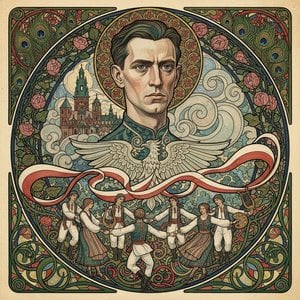
Eugeniusz Marcin Kazimirowski: The Painter Behind Poland’s Sacred Icon
Eugeniusz Marcin Kazimirowski (November 11, 1873 – September 23, 1939) stands as a pivotal figure in Polish art history, largely recognized for his singular contribution to the creation of the Divine Mercy image—a devotion that has resonated globally and cemented its place within Catholic iconography. Born in Horishnia Vyzhnyanka, Ukraine (then part of Austro-Hungarian Empire), Kazimirowski’s artistic journey began with formal training at Kraków Academy of Fine Arts between 1892 and 1897, followed by further studies in Munich, Paris, and Rome—a testament to his ambition and dedication to mastering European artistic traditions. Kazimirowski's style leaned heavily toward realism, reflecting the broader trends of the era yet imbued with a deeply personal sensitivity. He excelled particularly in landscape painting, capturing the serene beauty of Ukrainian vistas and Polish countryside with meticulous detail and tonal subtlety. However, his fame rests primarily on one extraordinary commission: the depiction of Mary Immaculate Heart of Jesus, venerated as Divine Mercy, based on a fervent prayer uttered by Faustyna Kowalska and her spiritual director, Michael Sopółko. This image quickly gained immense popularity and became a symbol of Polish Catholic piety. The genesis of Kazimirowski’s masterpiece involved extensive research into Byzantine iconography and artistic techniques. He painstakingly recreated the traditional depiction of Mary Immaculate Heart of Jesus, incorporating elements of symbolism—the radiant aureole representing divine grace, the thorns symbolizing suffering endured by Our Lady—to convey profound spiritual emotion. The painting's meticulous execution showcased Kazimirowski’s mastery of oil paint and glazing methods, resulting in a luminous surface that captures the ethereal quality of religious devotion. Kazimirowski’s artistic career extended beyond landscape commissions; he actively engaged in theatrical design, contributing to productions in Vilnius—a city he adopted as his home after World War I—and fostering artistic education through his role at Vilnius Teacher Training Institute. Tragically, Kazimirowski's life was cut short during the Second World War, and much of his oeuvre vanished amidst the devastation of the conflict. Despite this loss, Kazimirowski’s legacy persists in the enduring veneration of the Divine Mercy image and continues to inspire artists today. His contribution to Polish art history is undeniable—a testament to a singular talent devoted to capturing the essence of faith and beauty.- Notable Works: Landscapes featuring Ukrainian scenery, Portraits reflecting humanist ideals.
- Influences: Byzantine Iconography, Impressionism
- Artistic Techniques: Oil Painting, Glazing Method