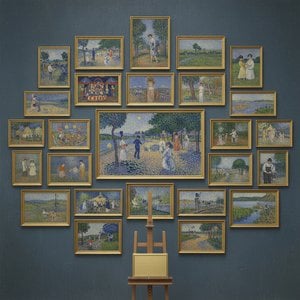
A Life Painted in Light: The Evocative World of Ernest George Tench
Ernest George Tench (1885-1942), though perhaps a name less immediately recognized than some of his contemporaries, occupies a fascinating and delicate space within the British art landscape of the early 20th century. His life, while not extensively documented, was one deeply immersed in artistic pursuit, marked by a sensitivity to light, color, and the fleeting beauty of the natural world. Born in England, Tench’s journey led him towards a style that blended Impressionistic techniques with a distinctly personal vision, often categorized within the broader movement of Giverny-inspired artists who sought to capture the essence of Claude Monet's idyllic scenes. He also worked under the pseudonym George Daniell.Early Influences and Artistic Development
Tench’s artistic education remains somewhat shrouded in mystery, but it is clear that he was profoundly influenced by the Impressionist movement. The shimmering surfaces and broken color of Monet, Renoir, and Pissarro are evident in his early works. However, Tench wasn't merely a copyist; he possessed an innate ability to translate these influences into something uniquely his own. His palette, while often bright and cheerful, reveals a subtle understanding of atmospheric perspective and the interplay of light on form. He gravitated towards landscapes and portraits, subjects that allowed him to explore his fascination with capturing ephemeral moments and the emotional resonance of color. A key aspect of his development was a period spent painting *en plein air*, directly from nature, which instilled in him a deep appreciation for observation and spontaneity. This dedication to direct experience is palpable in the freshness and vitality of his paintings.Themes and Techniques: Capturing Beauty’s Essence
Tench's oeuvre is characterized by a recurring set of themes – idyllic gardens, blossoming flowers, and intimate portraits, particularly those of children. His floral paintings are especially noteworthy, showcasing a delicate balance between realism and abstraction. He didn’t simply reproduce the appearance of flowers; he sought to convey their *feeling*, their fragrance, their transient beauty. This is achieved through his masterful use of color – soft pastels blending seamlessly into bolder hues, creating an almost luminous effect. His portraiture, while less prolific than his landscapes, reveals a sensitivity to character and emotion. Works like ‘Boy George’ demonstrate his ability to capture the innocence and vulnerability of youth with remarkable tenderness.Historical Significance and Legacy
While Tench may not have achieved widespread fame during his lifetime, his work represents an important strand within British Impressionism. He was part of a generation of artists who embraced modern techniques while retaining a distinctly English sensibility. His paintings offer a glimpse into a world of quiet beauty and refined elegance, reflecting the social and aesthetic values of the early 20th century. Today, Tench’s work is increasingly appreciated for its technical skill, emotional depth, and evocative power. He stands as a testament to the enduring appeal of Impressionism and the importance of capturing the fleeting moments that make life so precious. His paintings are sought after by collectors who appreciate his unique vision and the subtle charm of his artistic style.Selected Works & Notable Achievements
- Boy George: Perhaps his most recognizable work, a tender portrait capturing youthful innocence.
- Spring Flower: A quintessential example of his floral paintings, showcasing his mastery of color and light.
- Gardens at Giverny-inspired Landscapes: Demonstrating the influence of Monet and a dedication to *plein air* painting.
- Portrait Studies: Intimate portraits revealing sensitivity to character and emotion.
Spørgsmål og svar
Kan jeg udforske Ernest George Tenchs værker efter farvespektrum?
Ernest George Tenchs værker kan udforskes efter farve på kunstnerens Farveindeks side.
Hvor mange kunstværker af Ernest George Tench er tilgængelige at gennemse?
Du kan gennemse 24 kunstværker værker af Ernest George Tench på siden Alle kunstværker.
Hvor kan man finde Ernest George Tenchs værker grupperet efter kunstretning?
De kunstretninger, som Ernest George Tench arbejdede inden for, kan findes på kunstnerens Alle kunstretninger-side, hvor værkerne er grupperet efter kunstretning.