Ernest Crofts: A Master of Military History
Born in Leeds, England, in 1847, Ernest Crofts (RA) emerged as a significant figure in 19th-century British art, primarily recognized for his dramatic and meticulously rendered historical and military scenes. His life was inextricably linked to the tumultuous events of his time, particularly the Franco-Prussian War and the English Civil War, experiences that profoundly shaped his artistic vision and fueled his dedication to capturing pivotal moments with remarkable accuracy and emotional intensity. His lineage – a Justice of the Peace in Leeds, a vicar’s grandson, and a connection to the renowned Wordsworth family – provided him with a stable yet intellectually stimulating background, fostering an appreciation for both tradition and artistic exploration.
Crofts' early education at Rugby School laid the groundwork for his future pursuits. However, it was his relocation to Berlin that proved transformative, igniting a deep passion for art and ultimately leading him to commit to a career as a painter. This period marked a crucial shift; he immersed himself in European artistic traditions, particularly those of Düsseldorf, where he studied under Emil Hünten, a former pupil of Horace Vernet – a celebrated military artist for the Prussian Emperor. Hünten’s influence was paramount, instilling in Crofts a rigorous approach to depicting battle scenes, emphasizing realism, composition, and the psychological impact of warfare. The lessons learned within the Düsseldorf school instilled a deep respect for historical detail and a keen eye for capturing the nuances of human experience amidst conflict.
Early Military Experiences & Breakthroughs
Crofts’ artistic journey gained momentum during the Schleswig-Holstein War in 1864, an event that provided his first direct encounter with military life. Accompanying a Prussian doctor, he witnessed firsthand the brutal realities of combat around Düppel, an experience that would later inform many of his paintings. This exposure wasn't merely observational; it was deeply formative, shaping his understanding of war’s devastation and its profound effect on individuals. His sister, Ellen Wordsworth Crofts, married Sir Francis Darwin, a connection to the renowned naturalist Charles Darwin, further enriching his intellectual environment.
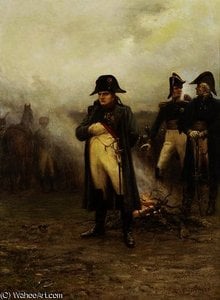
1874 marked a pivotal year for Crofts' career. His painting “Retreat,” depicting an episode from the Franco-Prussian War at Gravelotte, was exhibited at the Royal Academy and secured him the prestigious Crystal Palace Prize Medal – a testament to its technical brilliance and compelling narrative. The subsequent work, "One Touch of Nature Makes the Whole World Kin," continued the theme of the war, showcasing his ability to capture both the grand scale of battle and the intimate details of human suffering. These early successes established Crofts as a rising star in the British art scene, demonstrating his talent for translating historical events into powerful visual narratives.
London Years & Royal Academy Recognition
Returning to London, Crofts continued to refine his skills under A.B. Clay but soon found himself drawn back to Düsseldorf, where he established a home and cultivated relationships with fellow artists. It was in Germany that he met his future wife, further solidifying his artistic life. He consistently contributed to the annual Royal Academy exhibition, showcasing his evolving style and expanding his audience. His work during this period reflected a growing mastery of composition, color, and light – elements crucial for conveying the drama and intensity of his chosen subjects.
Notable works from this era include “Ligny” (1875), exhibited at both the Royal Academy and the International Exhibition in Philadelphia, and "The Morning of the Battle of Waterloo" (1896), a monumental painting that captured the dawn of the battle with remarkable detail. These paintings demonstrated his ability to not only depict military action but also to evoke the atmosphere and emotions associated with such events. The critic’s description of “The Morning of the Battle of Waterloo” as reminiscent of the French school highlights Crofts' commitment to realism and his understanding of capturing a specific mood or feeling within a historical scene.
Later Career & Legacy
In 1878, Crofts was elected an Associate of the Royal Academy, followed by full academician status in 1896. His later works often focused on the English Civil War, including depictions of Oliver Cromwell at Marston Moor and a series exploring the final moments of Charles I. He also undertook commissions for contemporary events, such as painting the distribution of war medals following the Boer War and a memorial portrait of Queen Victoria. Notably, he served as Keeper and Trustee of the Royal Academy from 1896 to 1911, overseeing its art schools and managing its extensive collection – a role that demanded both firmness and kindness, qualities he possessed in abundance.
Ernest Crofts’ legacy extends beyond his individual paintings. He represents a significant bridge between Romanticism and the more realistic tendencies of late 19th-century art. His meticulous attention to detail, combined with his ability to convey the drama and emotional weight of historical events, cemented his place as one of Britain's foremost military painters. His work continues to be studied and admired for its technical skill, narrative power, and enduring depiction of pivotal moments in history. A memorial dedicated to him stands in Holy Trinity Blythburgh, a fitting tribute to an artist who spent his life capturing the echoes of war and the complexities of human experience.
Spørgsmål og svar
Hvilken by og hvilket land er Ernest Crofts født i?
Ernest Crofts blev født i Leeds, i Storbritannien.
Hvor kommer Ernest Crofts fra?
Ernest Crofts blev født i Storbritannien.
Hvordan finder jeg værker af Ernest Crofts i en specifik farvepalette?
Se Ernest Croftss værker sorteret efter farvepalette på kunstnerens Efter farvepalet side.