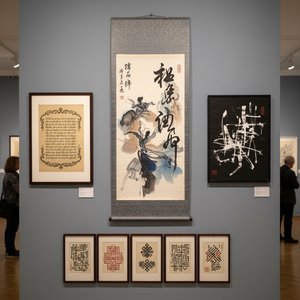
A Sovereign’s Brush: The Life and Art of Emperor Go-Yōzei
Emperor Go-Yōzei, born Katahito in Kyoto in 1571, occupied a unique position in Japanese history—a ruler deeply immersed in the aesthetic currents of his time. He wasn't merely a figurehead presiding over the tumultuous transition from the Azuchi–Momoyama to the Edo period; he was a highly accomplished calligrapher and poet, whose artistic endeavors reflected both the classical traditions of the imperial court and an emerging sensibility that foreshadowed the refined culture of the coming era. His reign, spanning 1586 to 1611, witnessed Japan consolidating after decades of civil war, and Go-Yōzei’s patronage of the arts played a subtle yet significant role in shaping the nation's cultural identity. He was the 107th emperor of Japan according to traditional succession, inheriting a legacy steeped in centuries of artistic refinement, but also facing the challenge of navigating a rapidly changing political landscape dominated by powerful figures like Toyotomi Hideyoshi and, later, Tokugawa Ieyasu.The Imperial Context: Lineage and Early Life
Go-Yōzei’s lineage was intrinsically linked to the shifting power dynamics of the late 16th century. He was the eldest son of Prince Masahito, who himself was a son of Emperor Ōgimachi. This familial connection placed Go-Yōzei within a complex web of imperial and aristocratic relationships. His upbringing in the Dairi, the imperial palace grounds in Kyoto, instilled in him a profound respect for classical learning and artistic expression. The court environment fostered an appreciation for *waka* poetry—a traditional Japanese form consisting of thirty-one syllables—and calligraphy, skills that Go-Yōzei would cultivate with remarkable dedication. Before ascending to the throne, his personal name was Kazuhito, but upon becoming emperor, he adopted the name Go-Yōzei, a deliberate invocation of Emperor Yōzei from the 9th century, signifying a continuation of artistic and cultural values. The prefix “Go,” meaning ‘later,’ underscored this connection to the past while simultaneously establishing his own distinct identity within the imperial lineage.Artistic Pursuits: Calligraphy, Poetry, and Patronage
While political maneuvering occupied much of his reign, Go-Yōzei’s true passion lay in artistic creation. He was celebrated as a master calligrapher, renowned for his elegant brushwork and innovative style. His calligraphy wasn't simply an exercise in technical skill; it was deeply imbued with personal expression and spiritual contemplation. He favored *sumi-e* ink paintings, often incorporating natural motifs—landscapes, flowers, birds—into his compositions. These works weren’t merely decorative; they were intended to evoke a sense of harmony between humanity and nature, reflecting the Zen Buddhist principles that permeated court culture. Beyond calligraphy, Go-Yōzei was also an accomplished *waka* poet, composing numerous albums filled with verses that explored themes of love, loss, and the transience of life. His poetry often served as inspiration for his calligraphic works, creating a synergistic interplay between visual art and literature. He actively encouraged artistic endeavors within the court, fostering a vibrant creative environment and commissioning works from talented artists.Navigating Power: Hideyoshi, Ieyasu, and Imperial Authority
Go-Yōzei’s reign coincided with the rise of Toyotomi Hideyoshi, who unified Japan after centuries of conflict. While Hideyoshi held the real political power, Go-Yōzei skillfully maintained a degree of imperial authority through strategic alliances and cultural diplomacy. He understood the importance of symbolism and used his artistic patronage to legitimize Hideyoshi’s rule while simultaneously preserving the dignity of the imperial court. Later in his reign, he formally bestowed the title of *shogun* upon Tokugawa Ieyasu in 1603, solidifying Ieyasu's position as the new military ruler of Japan and ushering in the Edo period. This act was a crucial moment in Japanese history, marking the transition from a fragmented feudal system to a centralized shogunate. Go-Yōzei’s decision to grant this title underscored his ability to navigate complex political realities while upholding the traditions of imperial legitimacy.Legacy and Historical Significance
Emperor Go-Yōzei abdicated in 1611, passing the throne to his son, who became Emperor Go-Mizunoo. He died five years later, leaving behind a legacy as one of Japan’s most artistically gifted rulers. His calligraphy and poetry continue to be admired for their elegance, innovation, and spiritual depth. He was the last emperor depicted in traditional medieval style—with facial hair—in his official portrait, symbolizing a connection to an earlier era. The shift towards clean-shaven portraits of subsequent emperors reflected the changing aesthetic sensibilities of the Edo period. Go-Yōzei’s reign bridged two distinct periods in Japanese history, and his artistic endeavors played a vital role in shaping the cultural landscape of the nation. He demonstrated that even within the confines of political constraints, an emperor could exert influence through the power of art, leaving an enduring mark on Japan's rich cultural heritage.Spørgsmål & svar
Hvilke pseudonymer eller andre navne bruger Emperor Go-Yōzei?
Emperor Go-Yōzei optræder under de alternative navne 後陽成天皇.
Kan jeg gennemse Emperor Go-Yōzeis værker efter stemning?
Emperor Go-Yōzeis værker kan gennemses efter stemning på kunstnerens Stemningsrum-side, som arrangerer kunstværkerne efter deres registrerede stemninger.
Hvor mange kunstværker af Emperor Go-Yōzei er tilgængelige at gennemse?
Du kan gennemse 2 kunstværker værker af Emperor Go-Yōzei på siden Alle kunstværker.