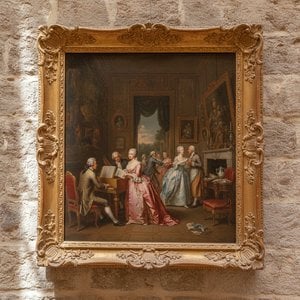
A Legacy of Lineage: The Artistic Roots of Édouard Toudouze
To understand the artistry of Édouard Toudouze, one must first look to the vibrant, creative tapestry from which he was woven. Born in 1848 into a family where art was not merely a profession but a shared language, Toudouze’s early life was steeped in the traditions of French visual storytelling. His father, Auguste Gabriel Toudouze, an architect and engraver, provided a foundation of structural precision, while his mother, the celebrated illustrator Adèle Anaïs Colin, connected him to a prestigious lineage descending from Jean-Baptiste Greuze. This environment, rich with the influence of illustrators, painters, and engravers, nurtured a profound appreciation for meticulous craftsmanship and the delicate art of capturing life's fleeting moments.
His formal education further refined this innate talent. After studying at the Collège Sainte-Barbe in Paris, Toudouze entered an apprenticeship under the esteemed Isidore Pils, a period that bestowed upon him the rigorous technical mastery required of a true academician. This disciplined training allowed him to navigate the complex artistic landscape of late 19th-century France, a time when the rigid structures of Academicism were beginning to encounter the revolutionary, light-drenched spirit of Impressionism.
Mastery of the Everyday: The Soul of Genre Painting
While many of his contemporaries sought fame through grand historical or mythological spectacles, Toudouze found his true calling in the intimate and the everyday. He became a master of genre painting, a style dedicated to portraying scenes of domestic life, social interactions, and the quiet beauty of common existence. His work is characterized by an extraordinary ability to imbant even the simplest subject with warmth, realism, and an understated elegance. Rather than choosing sides in the heated debates between traditionalists and modernists, Toudouze synthesized these movements, utilizing precise, academic detail while subtly embracing the atmospheric innovations of his era.
His canvases often feel like windows into a lost world, where light and shadow dance across textures of fabric and skin with breathtaking accuracy. This dedication to realism was not merely about imitation but about emotional resonance; he sought to elevate the mundane to the level of high art. His achievements in this realm were widely recognized by the institutional gatekeepers of his time:
- The Prix de Rome: In 1867, his talent for classical themes was cemented when he received this prestigious award for his work “Blind Oedipus.”
- Exposition Universelle: His continued excellence earned him a gold medal at the 1889 Universal Exposition in Paris.
- Légion d’Honneur: His contributions to French culture led to his appointment as a knight of the order in 1892, eventually rising to the rank of officer in 1903.
A Versatile Visionary: Beyond the Canvas
The scope of Toudouze’s creativity extended far beyond the boundaries of oil painting. He was a true decorative artist, possessing a versatility that allowed him to leave his mark on various media and public spaces. His artistic vision breathed life into the Opéra-Comique, where he executed delicate decorative work, and his historical passion found expression in a series of models depicting the history of Brittany. These designs were so evocative that they were transformed into magnificent tapestries at the Manufacture des Gobelins, destined for display in the Palais du Parlement de Bretagne.
Furthermore, Toudouze’s gift for narrative made him a sought-after illustrator. His pen brought literary giants to life, as he produced intricate illustrations for the works of Sir Walter Scott, Théophile Gautier, and Prosper Mérimée. Perhaps most notably, his ability to capture character was utilized in illustrating numerous volumes of Honoré de Balzac’s monumental La Comédie Humaine. Through these diverse endeavors—from the grand scale of tapestries to the intimate detail of book illustrations—Édouard Toudouze remains a pivotal figure whose work bridged the gap between tradition and modernity, ensuring that the beauty of the human experience was preserved for generations to come.