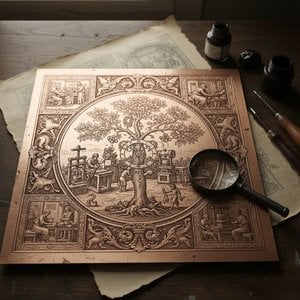
Diane Victor: A South African Voice Against the Grain
Born in Witbank, South Africa, in 1964, Diane Victor’s artistic journey is inextricably linked to the tumultuous history of her nation – a landscape scarred by colonialism, apartheid, and its lingering effects. From an early age, she possessed a keen observational eye and a profound understanding of social injustice, qualities that would become central themes in her powerful and often unsettling body of work. Her formal training at the University of the Witwatersrand provided a solid foundation in drawing and printmaking, but it was Victor’s relentless pursuit of truth and her willingness to confront uncomfortable realities that truly defined her artistic trajectory.
Victor's early career saw her experimenting with various media, including charcoal drawings and etchings. However, it was the introduction of smoke drawings and ash drawings in the late 1980s – a technique she essentially invented – that would become her signature style. This innovative approach, utilizing the ephemeral nature of smoke to capture fleeting moments and create hauntingly beautiful portraits, allowed her to explore themes of vulnerability, loss, and the fragility of human existence with unparalleled depth. The transient quality of the medium itself mirrored the precariousness of life under oppressive regimes and the constant threat of violence that permeated South African society.
The Weight of History: ‘Birth of a Nation’ and Beyond
Victor's most significant contribution to contemporary art lies in her exploration of colonial history and its enduring legacy. Her 2009 print portfolio, *Birth of a Nation*, is a masterful example of this thematic focus. Drawing heavily on historical references – particularly the iconography of colonialism and the exploitation of African resources – Victor constructs complex narratives that expose the systemic corruption and ongoing injustices inherent in neo-imperialist structures. The series isn’t simply a historical recounting; it's a visceral critique, employing mythological allusions and unsettling imagery to force viewers to confront uncomfortable truths about their own complicity.
Building upon this foundation, Victor has continued to develop her artistic voice through a series of powerful prints, most notably *Disasters of Peace* (2001). This ambitious project directly references Francisco de Goya’s seminal work, *Disasters of War*, but instead of depicting the horrors of battle, Victor focuses on the everyday violence and systemic failures that continue to plague South Africa. Through meticulously detailed etchings, she exposes the subtle yet pervasive forms of oppression – from political corruption to economic inequality – highlighting how war is not merely a distant event but an ongoing reality.
A Goya-Inspired Vision: Technique and Symbolism
Victor’s artistic style is characterized by a remarkable command of technique, particularly in her printmaking. She seamlessly blends traditional methods with innovative approaches, demonstrating a deep respect for the history of print media while simultaneously pushing its boundaries. Her use of *pointillisme* – creating images through tiny dots of ink – allows her to build up layers of texture and detail, imbuing her work with a remarkable sense of depth and realism. Furthermore, she skillfully employs techniques like *l'eau-forte*, *aquatint*, and *drypoint* to achieve a wide range of tonal values and expressive effects.
Beyond technical mastery, Victor’s work is rich in symbolism. Her self-portraits frequently serve as anchors for her narratives, allowing viewers to connect with the emotional core of her subjects. Recurring motifs – such as masks, shadows, and fragmented figures – carry layers of meaning, representing themes of identity, concealment, and vulnerability. The deliberate use of color—often muted earth tones punctuated by flashes of vibrant red—further enhances the evocative power of her imagery.
Legacy and Influence
Diane Victor’s work has garnered critical acclaim both within South Africa and internationally. Her unflinching honesty, technical skill, and profound social commentary have established her as a leading voice in contemporary art. Awards such as the L'Atelier Award (1988) and the Sasol New Signatures Award (1987) recognized her talent early on, while exhibitions at prestigious venues like MoMA New York and the Tate Modern have cemented her place within the global art community.
More than just an artist, Victor is a chronicler of her time – a witness to the ongoing struggles for justice and equality in South Africa. Her work serves as a powerful reminder of the importance of confronting difficult truths and holding those in power accountable. As she herself has stated, “My aim is not simply to depict reality but to provoke reflection and inspire action.”