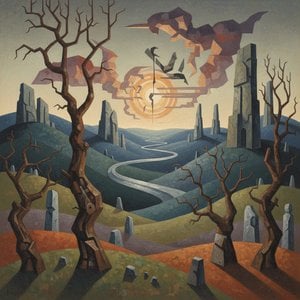
David Jones (Poète): A Weaver of Welsh Myth and Modernist Vision
Born in Brockley, London, in 1895, David Jones was more than simply an artist; he was a poet, engraver, calligrapher, illustrator, and a profound explorer of the intersection between faith, myth, and the modern world. His life, marked by both artistic brilliance and personal struggles, culminated in a body of work that continues to resonate with its haunting beauty and intellectual depth. Jones’s heritage—a Welsh father steeped in folklore and language, coupled with a Catholic upbringing—formed the bedrock of his creative vision, informing every brushstroke, every etched line, and every carefully crafted word.
Early influences were diverse yet formative. He began drawing at a young age, nurtured by his father’s appreciation for printmaking. His time at Camberwell School of Art exposed him to the Impressionists and Pre-Raphaelites, artists who valued beauty, narrative, and symbolic representation—qualities that would become central to Jones's own artistic practice. However, it was his encounter with Eric Gill and the Roman Catholic community at Ditchling that truly shaped his trajectory, introducing him to a world of ritual, symbolism, and a profound engagement with Christian iconography.
The War Years and Artistic Transformation
World War I profoundly impacted Jones’s life and work. Enlisting in the Royal Welch Fusiliers, he experienced firsthand the horrors of trench warfare, an experience that deeply scarred him and fueled his artistic exploration of trauma, loss, and the disintegration of meaning. This period produced *In Parenthesis*, a monumental poem published in 1937—a sprawling, multi-layered work that defies easy categorization. It’s a fragmented narrative, blending prose, poetry, and visual imagery to depict the psychological and spiritual devastation of war, viewed through the eyes of Private John Ball. The poem's innovative structure and intensely personal voice established Jones as a major figure in modernist literature.
Following the war, Jones continued to develop his artistic practice, experimenting with watercolour, engraving, and calligraphy. He sought to integrate these mediums into a cohesive visual language, creating works that were both aesthetically stunning and intellectually stimulating. His paintings often depicted scenes from Welsh mythology, biblical narratives, and Arthurian legends—subjects imbued with symbolic weight and personal significance. His engravings, particularly those produced in collaboration with Gill, showcased his remarkable technical skill and his ability to capture the essence of his subjects with exquisite detail.
A Synthesis of Faith and Art
Jones’s artistic vision was inextricably linked to his Catholic faith. The Latin Mass became a central source of inspiration for his work, providing him with a framework for exploring themes of sacrifice, redemption, and the eternal. He saw art as a means of engaging with the sacred—a way to translate religious experience into visual and literary form. This commitment is powerfully evident in *The Anathemata* (1952), a sprawling philosophical poem that traces the history of Western culture through the lens of the Mass, revealing connections between myth, religion, and human consciousness.
His work wasn’t solely focused on religious themes; Jones also produced evocative landscapes and portraits. His watercolors captured the beauty of the English countryside, while his portraits revealed a keen eye for capturing the inner lives of his subjects. He was particularly drawn to Welsh scenes—rolling hills, dramatic coastlines, and ancient ruins—evoking a deep sense of connection to his ancestral homeland.
Legacy and Recognition
Despite facing periods of personal struggle and relative obscurity during his lifetime, David Jones’s artistic legacy has grown steadily in recent decades. His work is now recognized as a pivotal contribution to both British art and modernist literature. He received significant accolades for his achievements, including the Hawthornden Prize in 1938 and the Bollingen Prize in 1960—testaments to the profound impact of his creative vision. His influence can be seen in the work of numerous artists and writers who followed in his footsteps, and his innovative approach to combining visual and literary forms continues to inspire contemporary artists today.
Jones’s art remains a powerful testament to the enduring power of myth, faith, and imagination—a reminder that beauty and meaning can be found even in the darkest corners of human experience. His work invites us to contemplate our place in the world, to grapple with profound questions about existence, and to appreciate the transformative potential of art.