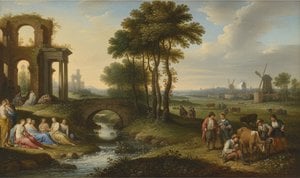
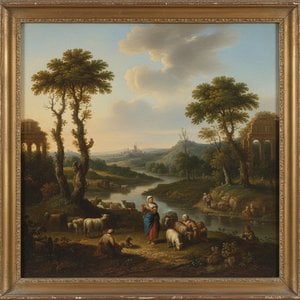
Cornelis van Noorde (1731 – 1795): A Master of Haarlem Landscapes
Cornelis van Noorde (1731 – 1795) stands as a pivotal figure in the artistic landscape of Haarlem during the Dutch Golden Age, renowned for his meticulous architectural drawings and evocative depictions of pastoral scenes. Born in Haarlem in 1731, he descended from a family rooted in Haarlem’s artisanal traditions—his father, Rijkes van Noorde, operated a bakery on Kleine Houtstraat and Patientiestraat—a connection that instilled within him an appreciation for detail and observation. His formative artistic education began under the tutelage of Frans Decker (1684–1751), a celebrated Haarlem landscape painter whose influence extended far beyond his immediate workshop, shaping van Noorde’s approach to capturing the beauty of the Dutch countryside. Following Decker's untimely death in 1751, Tako Hajo Jelgersma took over as mentor, further honing van Noorde’s skills and fostering a collaborative spirit that would characterize his subsequent artistic endeavors.
- Early Life & Family: Cornelis was the son of Rijkes van Noorde and Josina van de Berg, who ran a bakery in Haarlem's historic center. His brother Jacob continued the family business after his father’s passing in 1753.
- Guild Membership & Artistic Training: He joined the Haarlem Guild of St. Luke in 1761 and pursued formal artistic training under Frans Decker and Tako Hajo Jelgersma, immersing himself in the techniques and traditions of Haarlem painting.
The Influence of Frans Decker and Architectural Drawing
Frans Decker’s teachings profoundly impacted van Noorde's artistic vision, emphasizing accuracy, tonal subtlety, and a deep understanding of perspective—principles that would become hallmarks of his oeuvre. Decker championed the genre of architectural drawing, recognizing its importance in documenting the evolving cityscape and conveying spatial relationships with precision. This influence is evident in van Noorde’s extensive portfolio of drawings depicting Haarlem buildings before their demolition, demonstrating an unwavering commitment to preserving visual records of the past. These drawings aren't merely representations; they are painstakingly rendered explorations of light, shadow, and form—testaments to Decker’s legacy and van Noorde’s dedication to mastering architectural draughtsmanship.
- Decker’s Emphasis on Detail: Decker instilled in his pupils a meticulous attention to detail, mirroring the exacting standards demanded by Haarlem's artistic community.
- Architectural Drawing as Genre: Decker recognized the significance of architectural drawing for documenting urban spaces and conveying spatial accuracy.
Haarlemse Teekenacademie & Artistic Legacy
Cornelis van Noorde’s contribution extended beyond individual artworks; he played a crucial role in establishing Haarlemse Teekenacademie (The Haarlem Drawing Academy), founded in 1772 alongside Jelgersma, Hendrik Meijer, Christiaan Henning, Leendert Overbeek and Paul van Liender. Located in De Hulst—the home of Pieter Teyler van der Hulst—the academy aimed to cultivate the next generation of Dutch artists, fostering a tradition of observation and artistic excellence. Van Noorde’s involvement ensured that Haarlem continued its reputation as a center for artistic innovation and education. He served as director until 1781 when Vincent Jansz van der Vinne took over, continuing Teyler's Stichting’s mission to promote art and scholarship.
- Foundation of Haarlemse Teekenacademie: Van Noorde collaborated with Jelgersma and others to establish a prestigious drawing academy in Haarlem.
- Role as Director & Patronage: He served as director until 1781, overseeing the academy’s operations and supporting its artistic endeavors.
Notable Works & Artistic Style
Van Noorde's artistic style is characterized by a remarkable blend of realism and atmospheric perspective—a technique perfected through years of diligent practice. His landscapes capture the subtle nuances of light and shadow, conveying an impressionistic quality that anticipates later developments in Impressionism. However, his true genius lies in his architectural drawings, which are executed with breathtaking precision and detail, documenting buildings before their destruction with unwavering accuracy. These drawings stand as invaluable historical records—a testament to van Noorde’s artistic skill and his dedication to preserving the visual heritage of Haarlem. His sketchbook is held by the North Holland Archives and has been published as an important historical document.
- Realistic Landscape Paintings: Van Noorde's landscapes prioritize tonal subtlety and atmospheric perspective, capturing the essence of Dutch countryside scenes.
- Precise Architectural Drawings: He excelled in architectural drawings, meticulously documenting buildings with exceptional accuracy and detail—a genre that continues to inspire admiration today.
Concluding Remarks & Historical Significance
Cornelis van Noorde’s artistic legacy resides not only in his individual paintings but also in his role as a teacher and advocate for Haarlemse Teekenacademie, ensuring the continuation of Dutch artistic tradition. His meticulous drawings serve as invaluable records of Haarlem's architectural history—a testament to his dedication to preserving visual culture. As a painter who embraced both observation and technique with unwavering commitment, van Noorde embodies the spirit of the Dutch Golden Age, securing his place among the most celebrated artists of his era.