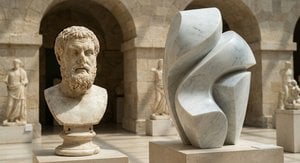
A Sculptor of Abstract Forms: The Life and Work of Christian Cassar
Born in Bolzano, Italy, in 1952, Christian Cassar emerged as a significant voice in the world of contemporary sculpture. His artistic journey began with formal training at the Academy of Fine Arts in Urbino, where he honed his skills not only in sculpting but also in painting. This foundational education proved pivotal, imbuing him with a versatile understanding of form and space that would later characterize his distinctive style. Cassar didn’t limit himself to creation; he shared his knowledge as an assistant professor of both painting and sculpture at the same institution where he once studied, nurturing the next generation of artists while continuing to refine his own practice.The Evolution of a Sculptural Language
Cassar's work is deeply rooted in abstraction, yet it’s not an abstraction devoid of meaning or connection. His sculptures often explore fundamental geometric shapes and forms, meticulously crafted to evoke a sense of balance, tension, and harmony. Early works demonstrate a clear fascination with the interplay of positive and negative space, hinting at influences from Constructivism and Minimalism—movements that prioritized pure form and rejected representational imagery. However, Cassar quickly moved beyond simple imitation, developing a unique sculptural language that incorporated organic elements alongside his geometric explorations. He wasn’t interested in replicating nature but rather in capturing its underlying principles of growth, decay, and transformation through the medium of stone and metal.Project Dolmen: A Landmark Achievement
Among Cassar's most notable achievements is ‘Project Dolmen,’ created in 1988. This sculpture stands as a testament to his ability to synthesize historical references with contemporary aesthetics. The title itself alludes to the prehistoric megalithic structures found across Europe, suggesting a connection to ancient rituals and beliefs. However, Cassar’s ‘Dolmen’ is not a literal reconstruction but rather an abstract interpretation—a series of interlocking forms that evoke the weight, permanence, and mystery of these ancient monuments. The use of black and white further emphasizes the sculpture's stark simplicity and symbolic power, inviting viewers to contemplate themes of time, memory, and human existence. It became a defining piece in his career, showcasing his mastery of form and material.Influences and Artistic Context
While Cassar’s work is distinctly personal, it exists within a broader artistic context shaped by several key influences. The Italian Arte Povera movement, with its emphasis on everyday materials and rejection of traditional art values, undoubtedly played a role in his exploration of unconventional forms and textures. Furthermore, the sculptures of Constantin Brâncuși—renowned for their simplified shapes and spiritual resonance—served as an inspiration, encouraging Cassar to pursue a similar path of reductive abstraction. His work also reflects a deep engagement with classical sculpture, particularly its emphasis on balance, proportion, and the human form, albeit filtered through a modern lens.Historical Significance and Contemporary Relevance
Christian Cassar’s contribution to contemporary art lies in his ability to create sculptures that are both intellectually stimulating and emotionally resonant. His work transcends stylistic boundaries, blending elements of abstraction, minimalism, and historical reference into a cohesive and compelling whole. He is recognized for his dedication to exploring the fundamental principles of form and space, creating works that invite viewers to engage in a dialogue with art on a deeper level. As contemporary sculpture continues to evolve, Cassar’s legacy as an innovator and visionary remains secure, inspiring artists and audiences alike to contemplate the power and beauty of abstract expression. His sculptures are not merely objects but rather portals—invitations to explore the complexities of human experience through the language of form.Spørgsmål & svar
Hvor kommer Christian Cassar fra?
Christian Cassar blev født i Italy.
Hvor kan jeg se Christian Cassars værker i kronologisk rækkefølge?
Christian Cassars værker kan ses i kronologisk rækkefølge på kunstnerens Tidslinje for kunstværker-side.
Kan jeg sortere Christian Cassars værker efter farve?
Siden Spektralt indeks organiserer Christian Cassars værker efter farve.