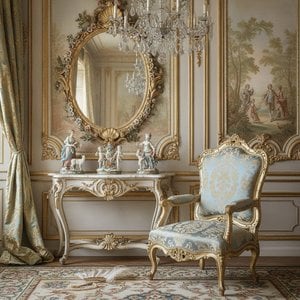
A Parisian Master of Rococo: Bernard II van Risamburgh
Bernard II van Risamburgh, a name whispered with reverence among connoisseurs of eighteenth-century French furniture, stands as one of the most celebrated ébénistes of the Rococo period. Though his full identity remained somewhat obscured for centuries—known primarily by the stamp “BVRB” on his exquisite creations—his work embodies the era’s spirit of refined luxury, technical innovation, and playful elegance. Born in Paris sometime after 1696 to a family with deep roots in Dutch cabinetmaking tradition, van Risamburgh inherited not only a craft but also a lineage of skilled artisans who had already established themselves within the bustling Parisian furniture-making district of the Faubourg Saint-Antoine.
His father, Bernard I van Risamburgh, arrived in Paris in 1696 and quickly integrated into the local guild system. The younger Bernard’s formal training likely occurred within his father's workshop, absorbing the techniques and aesthetic sensibilities of the time. However, it was Bernard II who truly elevated the family legacy, becoming a master craftsman by 1730. Unlike many of his contemporaries, van Risamburgh did not operate independently but relied entirely on collaborations with the powerful marchands-merciers—the sophisticated dealer-craftsmen who dictated trends and catered to the aristocratic elite.
The Art of Collaboration and Royal Patronage
This unique working relationship shaped van Risamburgh’s career. He rarely dealt directly with clients, instead fulfilling commissions channeled through figures like Lazare Duvaux and Thomas-Joachim Hébert. These marchands supplied the exotic materials—Japanese lacquer panels, precious woods, porcelain plaques—and dictated the overall designs, while van Risamburgh brought his unparalleled skill to their execution. This system allowed him to focus on the artistry of construction and embellishment, resulting in furniture that was both technically brilliant and visually stunning.
Van Risamburgh’s talent quickly attracted royal patronage. In 1737, a commode veneered with lacquer panels—supplied by Hébert—was delivered for use by Queen Marie Leszczyńska at Fontainebleau. This commission marked a turning point in his career, establishing him as a preferred artisan among the highest echelons of French society. Furniture bearing his stamp soon graced the residences of Madame de Pompadour, further solidifying his reputation and influence.
Innovation in Materials and Technique
What truly distinguished van Risamburgh’s work was his innovative approach to materials and technique. He pioneered the use of “trails of leaves and flowers” marquetry—intricate designs created from precisely cut pieces of quartered veneer, often purplewood highlighted with stained horn and ivory. His mastery of lacquer paneling, sourced primarily from Japan through Dutch traders in Amsterdam, transformed furniture into shimmering works of art. He wasn’t simply applying these materials; he was reimagining them, skillfully integrating them into harmonious compositions.
Beyond marquetry and lacquer, van Risamburgh embraced the emerging trend of porcelain plaques—delicate surfaces painted with idyllic scenes or intricate floral motifs—incorporating them into his designs with remarkable finesse. He also developed a distinctive style of gilt-bronze mounts, characterized by scrolling rocaille forms that echoed the naturalistic curves of Rococo ornamentation. These mounts were often unique to each commission, demonstrating his commitment to bespoke craftsmanship.
A Lasting Legacy
Despite his prominence, van Risamburgh’s identity remained largely unknown until the mid-twentieth century when archival research revealed the full extent of his family history and contributions. Today, his furniture is celebrated in museums worldwide—from the Getty Museum to the Metropolitan Museum of Art—as exemplars of eighteenth-century French luxury.
His influence extended beyond his own lifetime, inspiring generations of cabinetmakers with his technical skill, innovative designs, and unwavering commitment to quality. Bernard II van Risamburgh wasn’t merely a craftsman; he was an artist who transformed functional objects into symbols of status, taste, and the refined elegance of the Rococo era. His work continues to captivate and inspire, offering a glimpse into a world of unparalleled artistry and opulence.