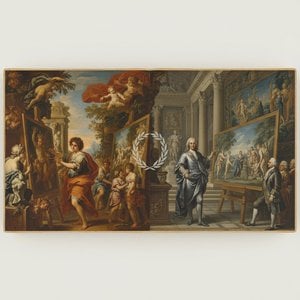
Benedetto Gennari II: A Baroque Prodigy Shaped by Guercino and Royal Patronage
Benedetto Gennari II (1633-1715) stands as a pivotal figure in Italian Baroque painting, inheriting the legacy of his father, Ercole Gennari, and cementing his family’s reputation for artistic excellence. Born in Cento, Italy, he was immersed in an environment steeped in artistic tradition from birth, destined to follow in the footsteps of Guercino—his grandfather—a master whose influence would profoundly shape Gennari's stylistic trajectory. This connection to Guercino wasn’t merely familial; it represented a formal apprenticeship at the renowned artist’s workshop, guaranteeing exposure to the very best of Baroque technique and aesthetic sensibilities.
Cesare Gennari, Benedictetto’s brother, joined him in this artistic endeavor, establishing a collaborative studio that would continue Guercino's tradition for decades. Unlike many artists of his time who adhered rigidly to established conventions, Gennari possessed an inquisitive spirit and actively sought inspiration beyond the confines of his teacher’s school. This restlessness propelled him eastward to Paris in March 1672, where he secured commissions from Louis XIV’s court—a move that solidified his position within the artistic landscape of Europe's most influential monarchy. The patronage of the French crown fueled his creativity and encouraged him to prolong his stay, resulting in a prolific output of portraits and allegorical scenes reflecting the grandeur and sophistication of the era.
September 1674 witnessed Gennari’s relocation to London, becoming court painter to King Charles II and subsequently James II. This transatlantic journey exposed him to new artistic currents, particularly those emanating from Northern Europe—influences he skillfully incorporated into his mature style. His commissions included depictions of prominent figures like Catherine of Braganza and Mary of Modena – Catholic wives of Protestant monarchs – tasked with creating artworks for private devotional purposes. These projects demanded meticulous attention to detail and a profound understanding of religious symbolism, showcasing Gennari’s versatility as an artist.
The tumultuous political climate of the Restoration ultimately forced Gennari's departure from England in 1689; he returned to Saint-Germain-en-Laye alongside James II’s court. By 1692, he had resettled in Bologna, continuing his artistic pursuits amidst a vibrant cultural milieu. Gennari’s contribution to the Bolognese art scene extended beyond mere production; he was one of the founding members of Accademia Clementina—an institution dedicated to fostering musical and artistic excellence—demonstrating his commitment to intellectual discourse alongside creative endeavor.
Gennari's distinctive style evolved over time, departing from Guercino’s initial influence to embrace Northern European techniques – a testament to his adaptability and engagement with broader artistic trends. His portraits are characterized by dramatic lighting effects and nuanced psychological portrayal, capturing the essence of his subjects with remarkable accuracy. Works like “Head of Saint Paul” exemplify this stylistic shift, demonstrating Gennari's ability to synthesize classical ideals with innovative approaches to composition and color. Furthermore, paintings such as "Nathaniel Cholmley" and "Lady Elizabeth Howard, Lady Felton, as Cleopatra," showcase his mastery of portraiture and his talent for conveying emotion through visual storytelling—establishing him as a true innovator within the Baroque tradition. Gennari’s legacy endures as a symbol of artistic excellence and intellectual curiosity, securing his place among the most celebrated painters of his time.