A Sculptor Forged in Displacement: The Journey of Bassel Al Saadi
Born in Beirut, Lebanon, in 1970, the life and art of Bassel Al Saadi are inextricably linked to a sense of place—and its often-painful absence. His early childhood was marked by displacement during the Lebanese Civil War, an experience that would profoundly shape his artistic vision and imbue his work with a poignant exploration of home, memory, and belonging. This initial upheaval led his family to seek refuge in Damascus, Syria, where he spent his formative years navigating a new cultural landscape while carrying the weight of a lost one. Though initially drawn to drawing as an escape from the constraints of formal education, Al Saadi ultimately found his calling in sculpture, but not in the traditional sense. He felt constrained by the mass and permanence of conventional sculptural materials, seeking instead a medium that could reflect the fragility and ephemerality he had come to know so well.
From Paper Studies to Steel Forms
Al Saadi’s artistic breakthrough came with his embrace of metal surfaces in 1999. He began experimenting with iron, a material often overlooked in favor of more “noble” mediums like bronze or marble within the Arab art world. This deliberate choice was not merely technical; it was a conscious act of questioning established aesthetic values and challenging perceptions of artistic worth. Early works centered around representations of the human head, gradually evolving into increasingly abstract forms. However, the true turning point arrived in 2004 with the creation of his “Boxes.” These weren’t literal containers but rather conceptual spaces—shelters, graves, wombs, prisons—reflecting both personal anxieties and the broader political climate of Syria under a repressive regime. The process was arduous; working under restricted conditions, Al Saadi meticulously crafted these forms from thin iron sheets, relying on minimal welding points to create a sense of precariousness and potential disintegration. This inherent instability mirrored the existential concerns of a generation living under constant threat.
The Origami Aesthetic: Lightness Within Weight
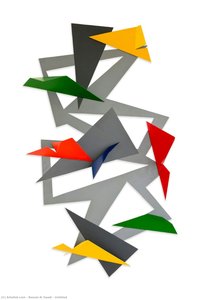
By 2010, Al Saadi’s work underwent another significant transformation—the introduction of color. What began as an “entertaining artistic experiment” blossomed into a vibrant exploration of form and composition. He started with paper studies, folding and manipulating the material to create intricate origami-like shapes. These delicate creations were then transposed onto steel, resulting in sculptures that possess a remarkable duality: they retain the lightness and fluidity of their original paper counterparts while simultaneously embodying the weight and solidity of metal. This juxtaposition is central to Al Saadi’s aesthetic—a constant tension between fragility and strength, hope and despair. He employs primary shapes and playful polka dots to disrupt the flatness and stillness of his work, inviting viewers to engage with the sculptures on multiple levels. The arrangements often evolve into assemblages, monumental public sculptures that transform urban spaces and offer moments of unexpected beauty amidst the concrete landscape.
Recognition and a Continued Exploration of Home
Al Saadi’s talent has garnered recognition through numerous exhibitions in Amman, Berlin, Damascus, Dubai, Enschede, and Paris. He is also known for conducting sculpting workshops internationally, sharing his unique techniques and inspiring new generations of artists. A particularly significant period in his career was his residency at Villa Romana in Florence from 2017 to 2018. This experience provided him with a sanctuary—a temporary “home” away from the escalating conflict in Syria—and allowed him to further refine his artistic vision. It was during this time that he created *Model for a Monument*, a sculpture embodying his ongoing preoccupation with the concept of home and the trauma of displacement. The work, intended for public installation, serves as a powerful testament to the enduring human need for shelter, belonging, and a sense of place.
A Legacy of Resilience
Bassel Al Saadi’s art is more than just aesthetically pleasing; it is a deeply personal and politically charged response to a world marked by conflict, displacement, and loss. His sculptures—with their vibrant colors, geometric forms, and inherent fragility—offer a poignant commentary on the human condition. He masterfully transforms a “poor” material into captivating works of art that challenge conventional notions of beauty and value. His ability to imbue steel with such lightness and emotion is a testament to his skill as an artist and his unwavering commitment to exploring themes of home, memory, and resilience. As he continues to create, Al Saadi’s work serves as a powerful reminder that even in the face of adversity, art can provide solace, hope, and a sense of belonging. He is not simply sculpting metal; he is forging a new narrative—one built on the foundations of displacement, memory, and the enduring human spirit.