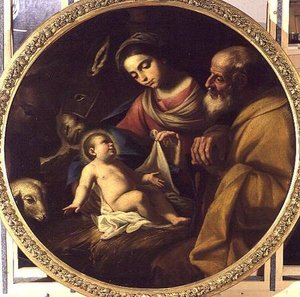
Andrea Vaccaro: A Leading Neapolitan Baroque Painter
- Born: Naples, Italy (1604)
- Died: 1670
Early Life and Training
Andrea Vaccaro was born in Naples in 1604, the son of Pietro Baccaro, a legal professional, and Gioanna di Glauso. Initially pursuing literary studies, he later turned to art. Contrary to earlier beliefs that he apprenticed under Girolamo Imparato, it is now known that Imparato died before Vaccaro began his artistic journey. At the age of 16, Vaccaro was apprenticed to Giovanni Tommaso Passaro, a lesser-known artist. Very little documentation exists regarding this early phase of his career.
Artistic Development and Influences
Around 1620, Vaccaro's paintings began exhibiting the influence of Caravaggio and his Neapolitan followers. He reportedly created a copy of Caravaggio’s “Flagellation,” which was once displayed alongside the original in San Domenico Maggiore. After 1630, Vaccaro broadened his artistic horizons, drawing inspiration from Guido Reni, Anthony van Dyck, and Pietro Novelli. He produced copies of their works for Neapolitan collectors and art dealers, suggesting he may have also been involved in art dealing himself – a common practice among Neapolitan painters of the time.
Career Highlights and Patronage
Vaccaro’s career flourished, with his paintings becoming highly sought after throughout Naples and beyond. He secured patronage from various sources, including religious orders and noble patrons in Spain, beginning around 1635. Notably, he received significant support from Gaspar de Bracamonte, the Spanish viceroy of Naples. The plague devastated Naples in 1656, claiming many artists, but Vaccaro continued to receive commissions, most notably for frescoes in the Theatine Church of San Paolo Maggiore – his sole fresco commission.
Legacy and Artistic Significance
Vaccaro was a founding member and head of the 'congrega dei ss anna e luca,' a painter's guild aimed at elevating the status of artists in Naples. Between 1650 and 1670, his art significantly influenced Neapolitan painting alongside figures like Massimo Stanzione and the emerging Luca Giordano. Vaccaro’s stylistic development is complex, initially marked by Caravaggio’s tenebrism before evolving to incorporate influences from Reni, Van Dyck, and Cavallino. His monogram, composed of interlaced "A" and "V" initials, appears on several of his works. Attributing authentic works remains challenging due to the large scale of his workshop and the prevalence of copies.