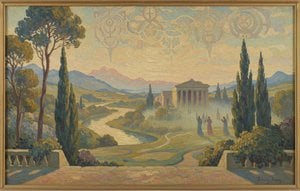
Francesco Clemente: A Weaver of Dreams and Myth
Francesco Clemente, born in Naples in 1952, is an Italian artist whose work has long captivated audiences with its evocative blend of ancient symbolism, personal mythology, and a distinctly contemporary sensibility. His journey as an artist began not within the confines of formal architecture training – he initially enrolled at the University of Rome – but through immersion in the vibrant artistic circles of the city, encountering figures like Luigi Ontani and Alighiero Boetti who profoundly shaped his early development. This exposure to diverse approaches, from performance art to conceptual installations, laid the groundwork for Clemente’s distinctive style, one that resists easy categorization yet consistently draws upon a rich tapestry of influences.
Clemente's formative years were marked by a significant sojourn to Afghanistan in 1974 with Boetti, an experience that deeply impacted his artistic vision and fueled a lifelong fascination with spirituality and the human condition. Returning to Rome, he began to establish himself as a key figure within the *Transavanguardia* movement of the 1980s – a reaction against the rigid formalism and conceptualism dominating the art world at the time. *Transavanguardia*, meaning “cross-guardianship,” sought to reclaim figurative painting, drawing inspiration from a wide range of sources including Renaissance masters, religious iconography, and popular culture. Clemente’s work within this movement was characterized by its dreamlike quality, often depicting scenes of mythic proportions populated with enigmatic figures engaged in ritualistic acts. His early drawings, particularly those reflecting childhood memories and subconscious imagery, demonstrated an immediate mastery of line and composition, hinting at the profound depth that would characterize his later oeuvre.
The Ballpoint Pen: A New Language
A pivotal moment in Clemente’s artistic evolution occurred in the 1970s when he began to experiment with the humble ballpoint pen as a primary medium. Initially, this seemingly simple tool became a vehicle for exploring themes of memory, identity, and the ephemeral nature of existence. He developed a unique technique involving layering hundreds, even thousands, of individual lines – often in shades of blue and black – creating dense, textured surfaces that shimmered with an almost hypnotic quality. This reductive approach, stripping away representational detail to reveal underlying patterns and rhythms, became his signature style. The repetitive nature of the process itself mirrored the act of remembering, transforming the mundane into something deeply resonant. As he stated, “I’m not interested in making a picture; I’m interested in making a feeling.”
Global Influences and Artistic Recognition
Clemente's artistic practice is profoundly shaped by his extensive travels and engagement with diverse cultures. He spent considerable time in India, immersing himself in its rich spiritual traditions and visual vocabulary – elements which are frequently incorporated into his work through motifs of Hindu deities, sacred geometry, and vibrant color palettes. His explorations extended to the United States, where he developed a deep appreciation for American art history, particularly the works of Cy Twombly, whose gestural abstraction served as an important influence. This global perspective is evident in his ability to synthesize seemingly disparate influences into a cohesive and deeply personal artistic language.
A Legacy of Symbolism and Innovation
Francesco Clemente’s impact on contemporary art extends far beyond the distinctive aesthetic of his ballpoint pen drawings. He has consistently pushed the boundaries of traditional media, embracing new techniques and approaches while remaining rooted in a deep respect for artistic heritage. His work has been exhibited extensively around the world, including major museums such as The Metropolitan Museum of Art, The Aldrich Contemporary Art Museum, and numerous institutions across Europe and Asia. His retrospective at the San Jose Museum of Art in 2007 cemented his position as one of the most important artists working today. Clemente’s legacy lies not only in the beauty of his art but also in its profound exploration of universal themes – memory, spirituality, identity – rendered with a singular vision and an unwavering commitment to artistic innovation. His work continues to invite viewers into a world of dreams, myths, and endless possibilities.