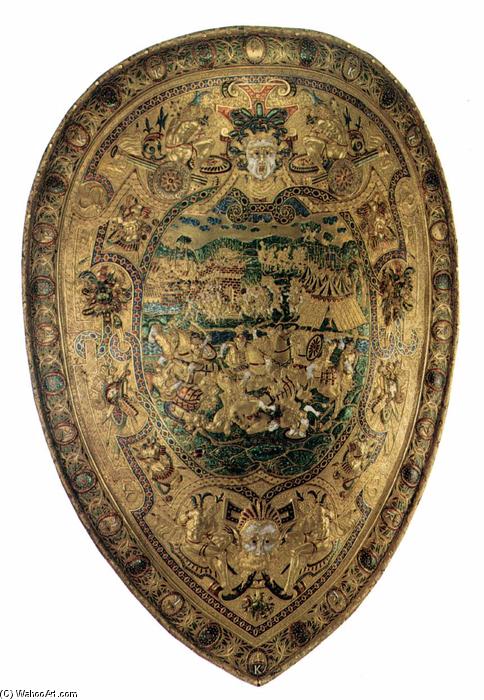
The Shield: A Testament to Renaissance Symbolism
Benvenuto Cellini’s “Shield,” completed in 1572, stands as a captivating emblem of the High Renaissance's waning influence and the burgeoning Mannerist style. Currently residing within the Louvre Museum’s halls in Paris, France—a testament to its enduring artistic merit—this sculpture transcends mere decorative form; it embodies a profound exploration of mythological narrative and masterful craftsmanship.
Style and Technique: Cellini's approach distinguishes itself from the idealized beauty championed by Raphael and Michelangelo. Instead, he embraces dramatic distortion and stylized realism, characteristic hallmarks of Mannerism. The shield’s surface is dominated by a rich golden hue—a deliberate choice reflecting the opulent tastes of Francis I—upon which intricate relief sculptures depict figures engaged in heroic action. Cellini meticulously employed techniques honed over decades of experience, demonstrating unparalleled control over material and form. The sculptor skillfully utilized wax modeling to achieve astonishing detail, capturing musculature and drapery with breathtaking accuracy.
- Material: Primarily gilded bronze
- Dimensions: 68 x 49 cm
- Provenance: Commissioned by Francis I of France
A Mythological Narrative Embodied in Bronze
The shield’s central scene portrays Perseus slaying Medusa, a tale steeped in Greek mythology and representing triumph over adversity. Cellini's depiction isn't merely faithful to classical iconography; it’s infused with Mannerist dynamism—the figures are contorted in poses that convey movement and emotion, pushing the boundaries of anatomical precision. This deliberate exaggeration serves not only to dramatize the narrative but also to elevate it beyond a simple retelling of legend.
Cellini's artistic vision aligns perfectly with the broader cultural landscape of his time. The Renaissance’s humanist ideals were giving way to an interest in psychological complexity and expressive distortion—themes that Cellini expertly translated into sculptural form. He sought to evoke contemplation and wonder, prompting viewers to consider not just what they saw but also what it meant.
Symbolism and Artistic Innovation
Beyond its mythological subject matter, “The Shield” speaks volumes about Cellini’s artistic philosophy. The golden background symbolizes divine majesty and reinforces the heroic grandeur of Perseus's quest. Geometric patterns—particularly spirals—are interwoven throughout the sculpture, reflecting a fascination with mathematical precision and hinting at an underlying spiritual order. Cellini’s mastery lies in his ability to combine visual splendor with intellectual depth.
As exemplified by works like “Perseus” and “Juno,” Cellini consistently prioritized artistic innovation over stylistic adherence—a defining trait of Mannerism. He challenged conventions, experimenting with form and technique to achieve unprecedented levels of expressive power. His legacy continues to inspire artists today who strive for similar boldness and sophistication.
Discovering the Cellini Legacy
A remarkable piece of art history, “The Shield” exemplifies Benvenuto Cellini’s unparalleled talent and artistic vision. Its intricate design, symbolic resonance, and masterful execution solidify its place among the greatest sculptures of the Renaissance. For those seeking to appreciate Cellini's genius firsthand or acquire a stunning reproduction, WahooArt.com offers exceptional quality prints that capture the essence of this iconic artwork.
Visit WahooArt.com to explore the extensive collection and delve deeper into Cellini’s life and artistic achievements!