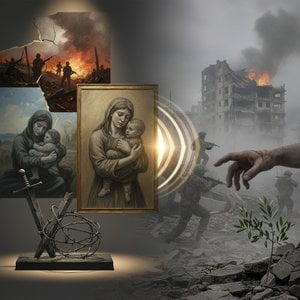
A Vision of Violence and Symbolism
Youssef Abdelke, born in the Syrian city of Qamishli in 1951, is an artist whose very existence and creative output are inextricably linked to the turbulent currents of history. A Syrian-French master of drawing and printmaking, his oeuvre serves as a profound meditation on war, trauma, and the fragile resilience of the human condition. His artistic journey has been shaped by the shadows of political upheaval and the weight of exile, experiences that have forged a visual language both hauntingly beautiful and unflinchingly raw. To encounter an Abdelke work is to step into a space where personal memory meets global tragedy, where the artist’s gaze pierces through the surface of objects to reveal the underlying anxieties of a society in conflict.
The foundations of his meticulous technique were laid at the Damascus Faculty of Fine Arts, from which he graduated in 1976. This period of formal training instilled in him a rigorous approach to observation, yet it was the political storms of the late 1970s that would truly define his artistic purpose. Following two years of imprisonment for his political activism, Abdelke was forced into exile in France. This displacement did not sever his connection to his homeland; rather, it expanded his perspective, allowing him to pursue advanced studies at the École Nationale Supérieure des Beaux-Arts and eventually earn a doctorate in Fine Arts from Paris XIII University. This duality of identity—rooted in the Levant but refined by the European academic tradition—is palpable in his work, which oscillates between the visceral energy of gestural abstraction and the chilling precision of meticulous realism.
The Language of Symbols and Shadows
Abdelke’s mastery extends across a diverse range of mediums, from the delicate application of pastels and charcoal on paper to the demanding, tactile processes of copper and zinc engraving. He utilizes these tools not merely for aesthetic effect, but as instruments of commentary. His celebrated series of still lifes stands as a testament to this symbolic depth. In these compositions, objects are arranged with a deliberate, almost ritualistic precision, yet they are often bound by heavy ropes or juxtaposed with unsettling elements such as skulls, knives, and fish. These are not mere studies of form; they are allegories of entrapment, mortality, and the pervasive threat of violence.
The artist’s work often functions as a mirror to the Syrian conflict, capturing the collective psyche of a people enduring unimaginable loss. He has famously remarked that his series attempt to express the emotions of the ordinary citizen amidst a "huge river of blood." Through his use of cynical figures and symbolic arrangements, he creates a space where the viewer is invited to contemplate the repercussions of war far beyond the immediate headlines. His ability to transform mundane objects into potent emblems of societal anxiety ensures that his work remains eternally relevant, transcending the specificities of time and geography.
Legacy and Recognition
The historical significance of Youssef Abdelke lies in his ability to transmute political dissent into high art, creating a visual record of resistance and mourning. His career has been marked by both immense triumph and profound personal struggle, including a period of re-arrest in Syria in 2013 following his public calls for political change. Despite these hardships, his reputation as one of Syria's leading contemporary artists remains unshakeable.
His contributions to the global art canon are recognized by some of the world's most prestigious institutions, with his works held in permanent collections including:
- The British Museum, London
- Institut du Monde Arabe, Paris
- Amman Museum of Modern Art, Jordan
- National Museum of Kuwait
Through his unwavering dedication to his craft, Abdelke has ensured that the voices silenced by conflict find a permanent, resonant echo in the halls of art history. His legacy is one of profound courage, using the permanence of print and drawing to confront the ephemeral and often devastating nature of human violence.