William Brassey Hole: Life & Art
William Brassey Hole (1846 – 1917) was a Scottish Victorian painter, illustrator, etcher, and engraver whose distinctive style combined meticulous observation of industrial landscapes with profound engagement with biblical narratives and Scottish national identity. Born in Salisbury, Wiltshire, England, Hole’s artistic journey began amidst personal tragedy—the untimely death of his father, Richard Hole, a physician, in 1849—leaving him to relocate to Edinburgh where he pursued his passion for art despite initial reluctance towards the engineering profession.Early Life and Education
His formative years were shaped by rigorous academic training at Edinburgh Academy followed by a five-year apprenticeship as a civil engineer – an experience that instilled discipline but ultimately fueled his desire to express himself creatively through painting. This dual path reflects the intellectual curiosity characteristic of Hole’s artistic temperament.Artistic Development & Influences
A pivotal moment arrived in 1869 when Hole embarked on a six-month sketching tour of Italy, specifically Genoa, where he encountered Keeley Halswelle—a mentor who provided invaluable guidance and critique—inspiring him to embrace painting as his primary vocation. Rome proved instrumental in solidifying his artistic ambitions, fostering connections with fellow artists and shaping his aesthetic sensibilities. He honed his skills at the School of Design and subsequently gained admission to the life school of the Royal Scottish Academy in 1873. Elected an associate RSA in 1878 and later a full member in 1885, Hole joined the Royal Society of Painters-Etchers (RE) and the RSW, establishing himself as a respected figure within Scotland’s artistic community.Artistic Style and Themes
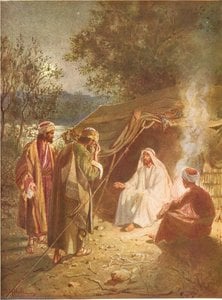
Hole distinguished himself through his specialization in industrial scenes—particularly depictions of Scottish collieries and factories—historical events like “End of the ‘45” commemorating Charles Edward Stuart's failed rebellion—and biblical narratives, notably “If thou hadst known,” “The Canterbury Pilgrims,” and “The Life of Jesus of Nazareth.” He possessed exceptional etching prowess, capturing subtle tonal variations and textural nuances with remarkable precision. His artistic vision prioritized conveying emotion alongside factual accuracy, resulting in works that resonated deeply with audiences.Major Works & Achievements
Among his most celebrated paintings are "End of the '45," a monumental depiction of the Battle of Culloden Moor; “Prince Charlie’s Parliament,” portraying the negotiations leading up to Stuart's exile; and “The Night’s Catch” and “The Fill of the Two Boats”—powerful representations of Scottish fishermen—which exemplify his ability to capture the spirit of everyday life. He created a monumental frieze for Edinburgh City Chambers depicting Scottish history, showcasing his mastery of mural decoration. Furthermore, Hole’s biblical illustrations were utilized in Robert Louis Stevenson's novel "Treasure Island" and J.M.W. Turner’s “The Fighting Temeraire,” demonstrating his versatility as an artist. His legacy endures through his works displayed prominently in institutions like the National Galleries of Scotland and Tate Britain, cementing his place as a pivotal figure in Victorian Scottish art history.Otázky a odpovědi
Kde mohu vidět díla umělce William Brassey Hole v chronologickém pořadí?
Existuje časová osa děl umělce William Brassey Hole: stránka Časová osa děl řadí díla podle data jejich vzniku.
Mohu si díla umělce William Brassey Hole seřadit podle barvy?
Spektrální index umělce William Brassey Hole je stránka, která organizuje jeho díla podle jejich barev.
Odkud pochází William Brassey Hole?
William Brassey Hole se narodil(a) v zemi Spojené království.