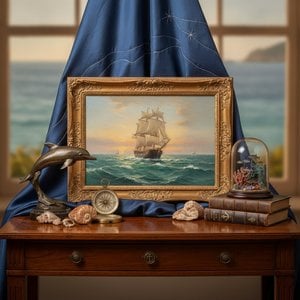
The Shipwright’s Vision: From Timber to Canvas
Born in Scotland in 1757, William Anderson did not begin his journey among the fine brushes of the academy, but rather amidst the scent of pine, tar, and salt spray. His early years as an apprentice shipwright provided him with a profound, tactile understanding of naval architecture—a technical mastery that would later become the very soul of his artistry. This foundational knowledge allowed him to render the complex rigging, the sturdy hulls, and the intricate construction of vessels with an unparalleled realism. When he eventually moved to London around the age of thirty, he brought with him more than just a painter's eye; he brought the disciplined precision of a craftsman who understood exactly how a ship met the sea.A Symphony of Light and Maritime Grandeur
As Anderson’s career flourished at the Royal Academy, where he exhibited with distinction for decades, his style evolved into a breathtaking marriage of British Romanticism and the luminous traditions of the Dutch Golden Age. One can sense the ghostly presence of masters like Rembrandt and Vermeer in his treatment of light and shadow. His works often captured the atmospheric drama of the maritime world, utilizing a palette that could shift from the murky, industrial depths of Limehouse Reach to the ethereal, sun-drenched expanses of a Seascape With Shipping. Through his brush, the sea was not merely a backdrop but a living, breathing protagonist, capable of both serene majesty and turbulent fury.A Legacy Etched in Salt and Gold
The historical significance of Anderson’s oeuvre is inextricably linked to the era of British naval supremacy. Painting through the tumultuous years of the French Revolutionary and Napoleonic Wars, he captured the very essence of a nation defined by its maritime prowess. His ability to document both the monumental and the intimate ensured his place in the canon of great marine artists. His most celebrated contributions include:- Seascape With Shipping, a breathtaking panorama of sailing vessels rendered in luminous watercolors.
- The Battle of Waterloo, a monumental work commemorating historical triumph.
- Nederlandse Kust-scene, which showcases his deep connection to the Dutch maritime tradition.
Today, the echoes of his craftsmanship can still be heard in the collections of the Victoria and Albert Museum and the National Maritime Museum, where his meticulous details continue to inspire awe in all who behold them.