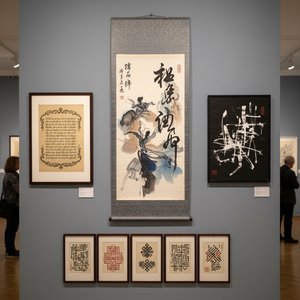
Wajih Nahle: A Pioneer of Lebanese Islamic Art
Born in Beirut, Lebanon, in 1932, Wajih Nahle’s life and artistic journey were inextricably linked to the rich cultural tapestry of his homeland. From a young age, he was immersed in the traditions of calligraphy and Arab art, disciplines that would profoundly shape his distinctive style and vision. His early exposure to painting began under the tutelage of Moustafa Farroukh, a respected Lebanese painter who instilled in Nahle a foundational understanding of artistic technique while simultaneously nurturing his innate creative spirit. This formative period laid the groundwork for his later exploration of decorative calligraphy, a central element that would define much of his work and distinguish him as a true innovator within the realm of Islamic art.
Early Career and Artistic Development
Nahle’s artistic trajectory took a significant turn in the mid-20th century, leading him to delve deeply into the intricate world of Arabic bas-reliefs. This shift wasn't merely a stylistic choice; it represented a conscious return to his roots – a deliberate reconnection with ancient oriental and Arab-Muslim artistic traditions. He sought to recapture the essence of these historical forms, imbuing them with a contemporary sensibility. His work during this period moved beyond simple representation, embracing fluidity, perpetual motion, and a dynamic interplay of color and form. This evolution can be seen as a rejection of rigid linearity in favor of an expressive language that conveyed both spiritual depth and vibrant energy.
A Fusion of Tradition and Innovation
Nahle’s artistic philosophy centered around meditation through the inner self, believing that true creativity stemmed from a profound connection to one's own emotions and subconscious. This internal landscape translated into his art, which often featured explosive motions in all directions – upward surges, downward flows, and intricate patterns designed to capture the viewer’s gaze and inspire contemplation. He skillfully blended traditional Islamic motifs with a distinctly postmodern approach, creating works that were both deeply rooted in history and strikingly original. His use of color was particularly noteworthy; he favored spontaneous, unrestrained application, allowing hues to blend and interact organically on the canvas, evoking feelings of nobility and freedom.
Exhibition Recognition and Honors
Throughout his prolific career, Nahle’s work garnered widespread recognition both within Lebanon and internationally. He exhibited in prestigious venues across Europe and the Arab world, including the Grand Palais in Paris, the Louvre Museum, and numerous galleries and museums from Dubai to Tunis. His achievements were formally acknowledged with several significant honors, including an honorary doctorate from the Lebanese American University in Beirut, the Prize of the Ministry of Education in Lebanon, and the Prize of Biennale of Alexandria, Egypt. He was also decorated as an Officier de l’Ordre des Arts et des Lettres by both Lebanon and France, a testament to his enduring contribution to the arts.
Legacy and Continuing Influence
Wajih Nahle passed away in 2017, leaving behind a remarkable body of work that continues to captivate and inspire. His innovative approach to Islamic art—particularly his masterful integration of calligraphy—has cemented his place as a pioneer in the field. His legacy extends beyond individual artworks; he demonstrated how ancient traditions could be revitalized and reimagined for contemporary audiences. Today, his paintings are displayed in major museums worldwide, ensuring that his unique artistic vision will continue to resonate with art lovers for generations to come. His work stands as a powerful reminder of the enduring beauty and spiritual depth found within Arabic art and culture.