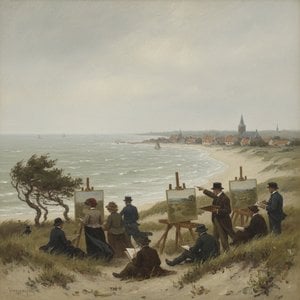
The Soul of the Russian Landscape: The Life of Vladimir Ovchinnikov
To wander through the canvases of Vladimir Ivanovich Ovchinnikov is to embark on a journey through the very heart of the Russian soul. Born on July 14, 1911, in the riverside city of Saratov, Ovchinnikov’s early life was deeply intertwined with the rhythmic pulse of the Volga River. Growing up in a peasant family, he possessed an innate connection to the vast, sweeping vistas and the humble beauty of rural life—a connection that would later become the cornerstone of his artistic legacy. His migration to Leningrad in 1932 marked the beginning of a profound transformation, as the boy from the Volga plains encountered the rigorous academic traditions and the avant-garde whispers of a burgeoning metropolis.
His formative years were shaped by an extraordinary intellectual crucible. Studying at the Saratov Art School and subsequently at the Vitebsk Art College, Ovchinnikov found himself under the tutelage of Kazimir Malevich. This encounter with Suprematism—the radical, geometric abstraction that sought to strip art down to its essential spiritual truths—left an indelible mark on his psyche. While he did not adopt the stark minimalism of his mentor, the lessons of structure and form remained embedded in his work. He eventually found his true voice by retreating from pure abstraction toward a deeply emotive realism, one that utilized impressionistic light to breathe life into the Soviet landscape.
A Master of Light and Atmosphere
As a prominent figure within the Leningrad School of Painting, Ovchinnikov developed a style that was both technically precise and poetically fluid. He moved away from the rigid constraints of academic realism to embrace a more lyrical approach, heavily influenced by the atmospheric sensitivity of Konstantin Korovin. His brushwork became a tool for capturing the ephemeral: the way sunlight dances upon the ripples of the Volga, the heavy, expectant stillness before a summer storm, or the silvered light of a winter dusk. Through his eyes, the Russian countryside was not merely a subject, but a living, breathing entity.
His repertoire of subjects reflected a deep devotion to the changing seasons and the quiet dignity of rural existence. One might find himself lost in the vibrant energy of "Windy Day on the Volga River" or moved by the somber, reflective beauty of "A Night Dock." His ability to manipulate texture and color allowed him to depict everything from the rugged terrain of Old Ladoga to the delicate, shimmering surfaces of river ice. There is a palpable sense of nostalgia in his work, a longing for the timelessness of the land that transcends the political turbulence of the 20th century.
Legacy and Historical Significance
Throughout his career, Ovchinnikov remained a dedicated member of the Leningrad Branch of the Union of Artists, contributing to the rich tapestry of Soviet art. His work serves as a vital historical document, capturing the essence of a landscape that was undergoing rapid social and industrial change. While much of the era's official art focused on the heroic narratives of Socialist Realism, Ovchinnikov offered something more intimate and enduring. He sought not to glorify the state, but to honor the earth.
The significance of his contribution lies in this delicate balance between realism and impressionism. By infusing traditional landscapes with a modern sensibility toward light and emotion, he helped ensure that the Leningrad School remained a vibrant, breathing movement. Today, his paintings stand as enduring testaments to a master who could find the infinite within the local, and the divine within the dirt of the Russian countryside. His life, which concluded in St. Petersburg in 1978, remains etched in every stroke of color he left behind on canvas.