The Architect of Light and Layer: The Legacy of Vicente Manansala
In the vibrant tapestry of Philippine modernism, few threads shine as luminously as those woven by Vicente Silva Manansala. Born in the quiet, culturally rich town of Macabebe, Pampanga, in 1910, Manansala’s journey was one of profound transformation—a movement from the pastoral rhythms of the barrio to the frenetic energy of the burgeoning metropolis. He did not merely observe this transition; he captured its very soul through a revolutionary visual language. As a pioneer of what would become known as transparent cubism, Manansala possessed the rare ability to bridge the gap between the rural simplicity of his heritage and the complex, often overwhelming, urbanity of a nation in flux under American influence.
His artistic foundation was laid with rigorous discipline at the University of the Philippines School of Fine Arts, where he studied from 1926 to 1930. Yet, it was his exposure to the wider world that truly ignited his genius. Through a UNESCO grant in 1949 and a prestigious scholarship from the French government in 1950, Manansala immersed himself in the avant-garde landscapes of Canada and France. In Paris, studying at the École des Beaux-Arts, he encountered the monumental influence of Fernand Léger. It was here that the seeds of his signature style were sown; Léger’s advice to simplify shapes and colors provided the catalyst for Manansala to move away from traditional fragmentation toward a more fluid, layered approach to form.
The Mastery of Transparent Cubism
What distinguishes Manansala from the heavy, opaque geometry of European Cubism is his breathtaking use of translucency. He developed a technique where figures and environments are not merely dissected into planes but are superimposed through delicate tones, shapes, and patterns. This transparent cubism allowed him to create an illusion of depth and luminosity that felt organic rather than mechanical. By utilizing meticulous glazing and layering, he could render the weight of a carabao or the tenderness of a mother’s embrace while allowing light to permeate the canvas, suggesting a world where boundaries between the self and the environment are beautifully blurred.
His subject matter served as a poignant social commentary on the Filipino condition. Manansala’s canvases often acted as windows into the intimate lives of the marginalized and the everyday. His works frequently explored themes such as:
- The Urban Struggle: Capturing the congestion, poverty, and grit of Manila life.
- The Rural Ideal: Honoring the enduring strength of the Filipino family, the dignity of labor, and the pastoral beauty of the provinces.
- Cultural Fusion: Illustrating the intersection of traditional customs and the encroaching modern way of life.
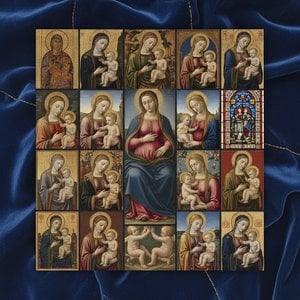
One of his most hauntingly beautiful masterpieces, Madonna of the Slums, exemplifies this duality perfectly. In it, he portrays a mother and child with a sense of profound sanctity, yet places them within the harsh, crowded reality of urban poverty, effectively elevating the struggle of the common person to the level of the divine.
A National Treasure and Enduring Influence
The historical significance of Vicente Manansala cannot be overstated. As a member of the "Thirteen Moderns," he was instrumental in breaking the stranglehold of academic realism on Philippine art, pushing the boundaries of abstraction and neo-realism. His ability to meld social commentary with high aesthetic innovation had a profound impact on subsequent generations of Filipino artists, including Angelito Antonio and Manuel Baldemor. He did not just paint scenes; he painted the identity of a nation navigating the complexities of modernity.
Throughout his life, Manansala’s work earned him the highest honors, culminating in his designation as a National Artist of the Philippines. His legacy is preserved in prestigious institutions worldwide, from the Philippine Center in New York to the Honolulu Museum of Art. When he passed away in Manila in 1981, he left behind more than just a collection of paintings; he left a visual vocabulary that continues to resonate, reminding us that even amidst the fragmentation of modern life, there is a luminous, interconnected beauty to be found.